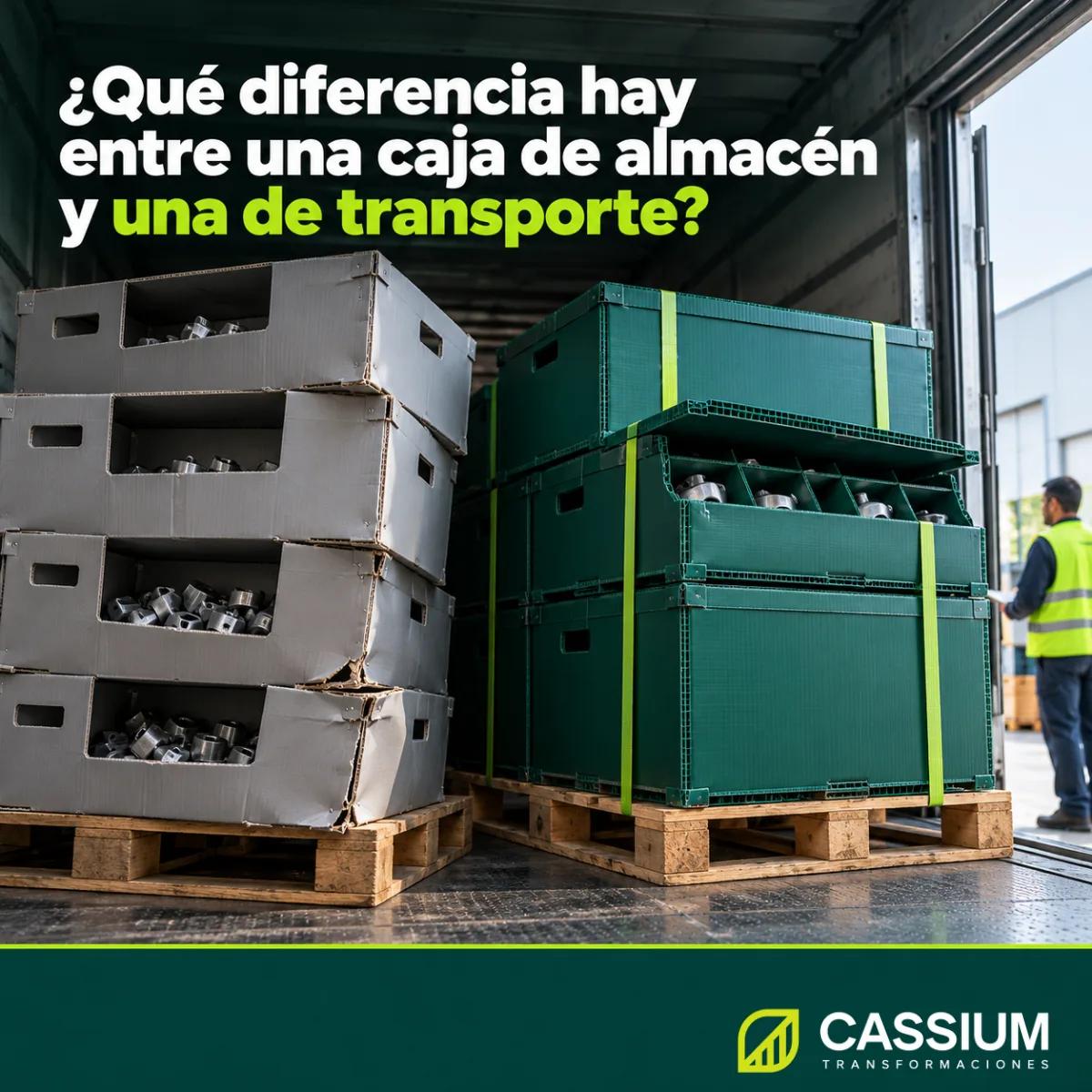
A storage box works standing still, with a constant load and frequent access to the part. A shipping box withstands vibration, impacts and stacking in motion, and its design handles that with gauge, joints, closure and internal restraint.
Why a box that lasts years on the rack fails on its first trip
From the outside, a storage box and a shipping box can look the same: the same material, a similar shape and close dimensions. The difference lies in the stresses each one takes during its cycle, and those stresses change completely once the box goes onto a truck.
Static load and dynamic load: two different stresses
On the rack, the box carries its own contents, at a fixed height and without movement. The operator pulls it out, takes a part and puts it back. The stress is constant and predictable, and the box withstands it for years.
On the truck, the same box takes a load that changes every instant. Vibration from the engine and the road, every stop, every curve and every pothole add forces the rack never asked of it. Walls, corners and joints work in every direction, and any weak point in the design shows up in the first hours on the highway.
Stacking in motion punishes the bottom box
A box at the bottom of a pallet carries the weight of every level above it. In the warehouse that weight stays still; in transit, every jolt pushes it down with more force than it would have at rest. That is why the bottom boxes are the first to collapse, and why the number of levels is a design figure as important as the weight of the part.
What a storage box needs
A box designed for the warehouse handles access, space and identification. Its design serves the person who picks from it several times a day and the rack where it lives.
Quick access to the part
In a picking box, the operator needs to see and take the part without moving the box. An open front, an access window or a low wall height cut the time of each pick. Those openings remove material from the wall, something the rack tolerates because there the box works with no weight on top.
Dimensions sized to the rack and the shelf
A storage box is sized from the space where it will live: the depth of the shelf, the height between levels and the width of the slot. If the box sticks out, it gets in the way in the aisle; if it falls short, it wastes space on every level. The rack sets the dimensions.
Identification visible from the aisle
The part number, the location and the quantity have to be readable from the aisle, without pulling the box out. Identification printed on the front, with one color per part family, speeds up picking and reduces location errors.
Load sustained for weeks
In the warehouse, the stress that matters most is a load held over a long time. When a box is stacked on the floor, with others on top, for weeks, the polypropylene can slowly deform under that constant weight. If your warehouse stacks boxes on the floor, the gauge is set with that height and that time in mind.
What a shipping box needs
A shipping box has one main job: to deliver the part to your customer's line in the same condition it left your plant. Every design decision serves that job.
Vibration and impacts: keeping the part still inside the box
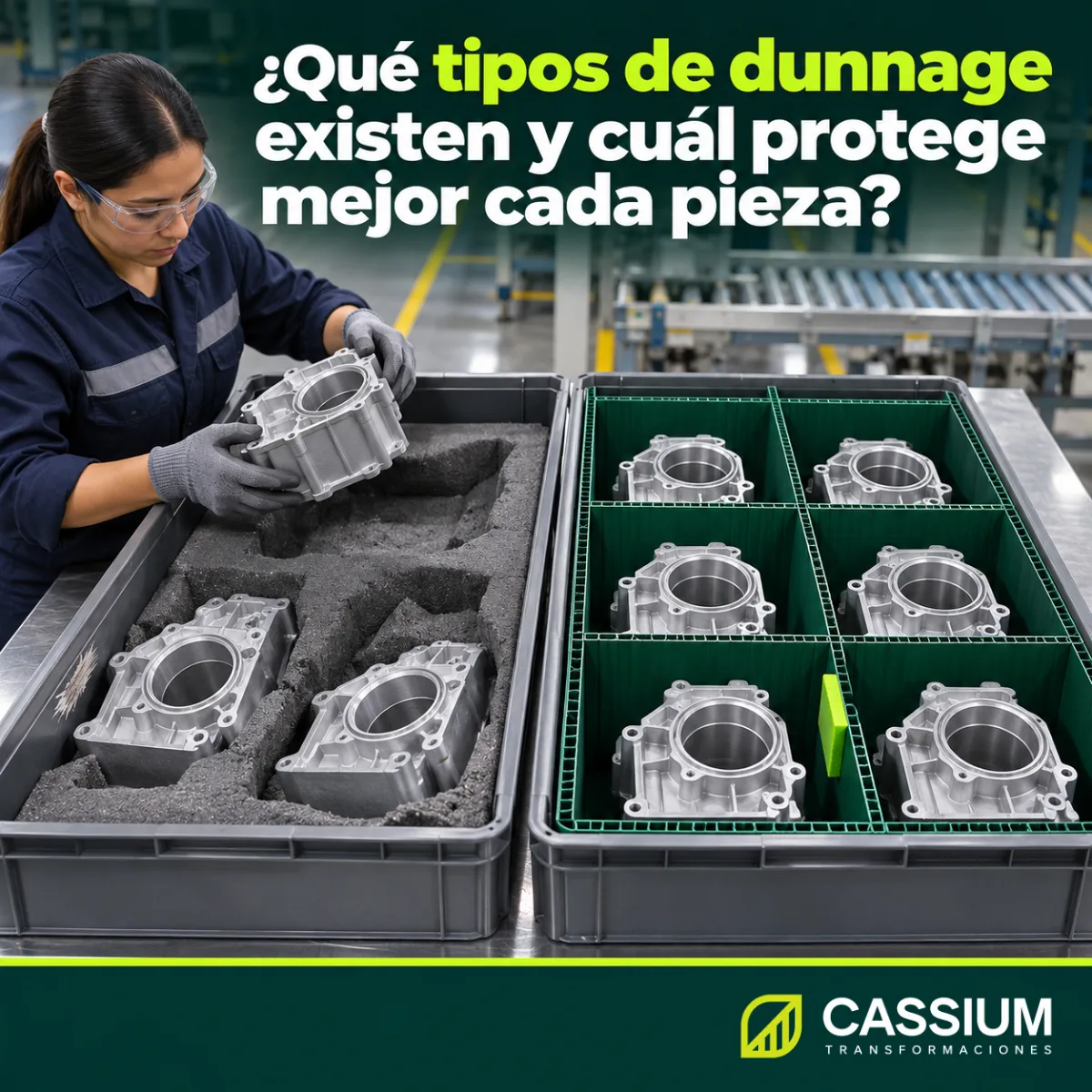
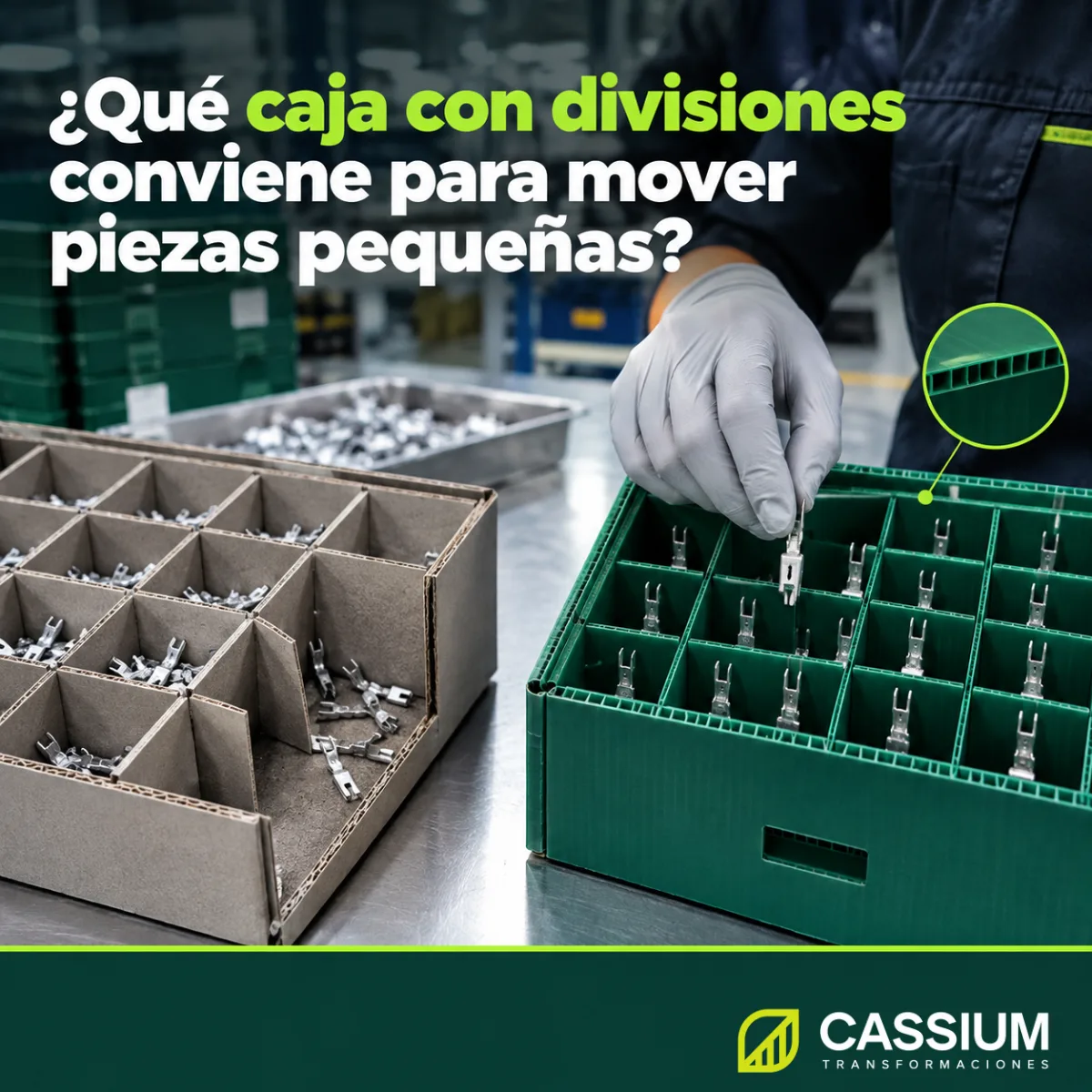
The most common cause of damage in transit is a part that moves inside the box. Every vibration knocks it against the wall or against another part, and the result is scratches, bent terminals or mixed parts. Dividers, dunnage separators and trays hold each part in position and eliminate that movement.
Joints and corners: where it fails first
A shipping box fails at the joint first, before the material of the body. Staples loosen with vibration and tape peels off with the humidity of the dock. Ultrasonic welding fuses the material along the joint line, with no adhesives or metal staples, and keeps the box closed cycle after cycle.
Gauge based on stacking and handling
The gauge of a shipping box is set by the weight of the part, the number of levels on the pallet and the type of handling: forklift, pallet jack or manual. A box with too little gauge collapses at the bottom; a box with too much gauge raises the cost of every part without adding protection.
Sized to the pallet and the truck
In transit, the box dimensions are set from the pallet. A box that covers the pallet without overhanging forms a stable stack, and one that hangs over the edges takes the forklift's impacts and destabilizes the whole load. The pallet pattern decides how many parts travel per shipment.
Lid, closure and the return trip
A lid protects the part from road dust and humidity, and provides a flat surface for the next level. If the box is returnable, the return trip counts too: a collapsible box takes up a fraction of the space on the return truck and frees up room on your customer's dock.
When one box has to do both jobs
In a closed loop, the same box travels to your customer's line, is used there as a picking box and comes back empty to your plant. In that case, the design has to handle both conditions.
Design for the most severe condition
The practical rule is to design for the strongest stress in the cycle, which in a returnable loop happens in transit. A box that withstands the highway withstands the rack; the reverse only works until the first shipment.
Access points that open on the line and travel closed
When your customer's line needs quick access to the part, the box can carry a window or a drop-down front that travels closed and opens at the station. That way the wall keeps its strength during the trip, and the operator takes the part without pulling the box off the rack. This kind of solution is validated with a prototype, because the drop-down front becomes a new joint that also has to withstand the cycles.
The mistakes that send back a full pallet
These are the mistakes we see most often when a storage box goes out on the highway:
- Calculating the gauge from the weight of the part, without counting the stacking levels.
- Shipping loose parts in a box without dividers or separators.
- Sending boxes with open access windows in the walls that carry the stack.
- Closing the box with staples or tape in a loop with many cycles.
- Using dimensions sized to the shelf that leave gaps or overhangs on the pallet.
Each one is detected in a prototype sent over the real route. Fixing it there costs a drawing adjustment; fixing it with the fleet in circulation costs rejected shipments and new boxes.
The data we need to design each one
To recommend a storage box, a shipping box or a box that does both, we ask for this data from the first conversation:
- The part or its drawing, with its actual weight.
- Parts per box and the number of stacking levels.
- The type of handling: forklift, pallet jack, conveyor or manual.
- The route: distance, road type and transit time.
- The dimensions of the rack or shelf where the box will live.
- The number of cycles you expect and whether the box comes back empty.
At Cassium Transformaciones we extrude our own corrugated polypropylene sheet and manufacture boxes, containers, trays and dunnage separators at the same plant in Monterrey, under an ISO 9001:2015 certified quality management system. We cut, fold, weld ultrasonically and print identification in the same place, and we design each returnable box to reach up to 40 uses with the normal handling of your loop. Before volume production we deliver a prototype so you can test it with your part, on your rack and on your route.
If your parts travel today in boxes designed for the rack, the next rejected pallet is only a matter of time. At Cassium Transformaciones we design the box for the real stress of its cycle, in storage, in transit or both, with a prototype before the fleet. Tell us how your parts travel on our contact page.