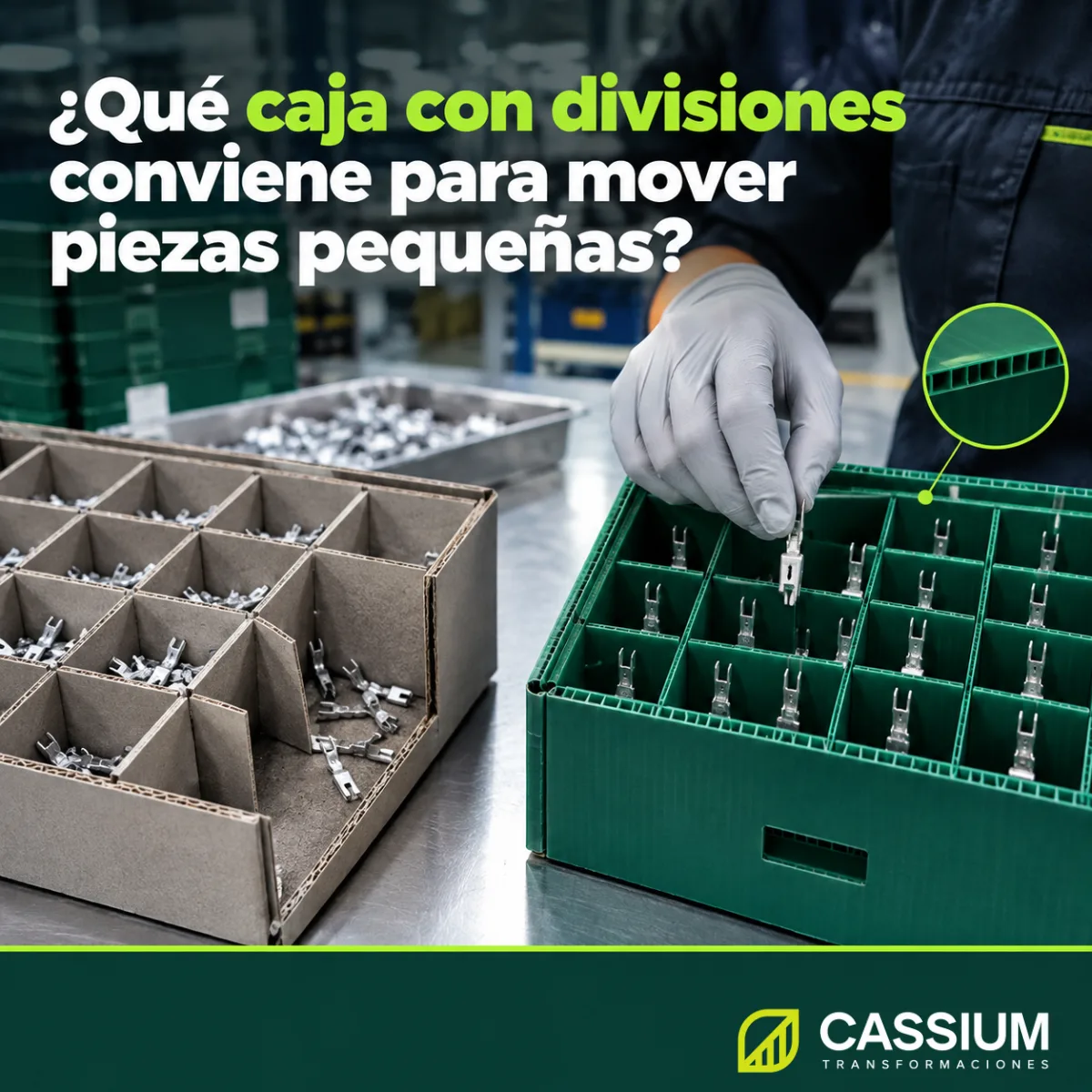
Small parts call for a box with cells sized to the part or to the quantity each cell delivers, dividers that seal against the walls and bottom, and a height that lets operators reach the last part.
Why a small part gets damaged or lost inside a large box
By small parts we mean the ones you can hold several of in one hand: fasteners, clips, terminals, connectors, seals, springs, bushings or electronic components. Each one is worth little and almost never gets packaging designed for it. The usual practice is to ship it loose, in a bag or an open box, together with hundreds of identical parts.
Bulk works until the part has a terminal that bends, an exposed thread, a sealing surface or a visible finish. It also stops working when your customer's line needs to count the parts, pick them in order or receive several part numbers together. In those cases, every vibration of the truck rubs the part against its neighbors, and the cost shows up at the assembly station as damaged, missing or mixed parts.
In another article we compared when a dunnage divider makes sense and when a tray does. Here we focus on the format used most for small parts, which borrows something from both: the divided box.
Bulk or fixed position: the decision that comes before the box
The first question is whether the part needs a place of its own. A sturdy part that is grabbed by the handful and counted by weight can ship in bulk in a large compartment. A fragile part, or one with functional surfaces, needs to be kept apart from the others, one per cell. Between those two extremes is the cell that holds a counted lot of identical parts, useful when the part tolerates contact with its twins and the line needs to know how many it receives.
Three types of divided box and the part each one protects
Corrugated polypropylene divided boxes are built in three main ways. Each one solves a different problem and has its own weak point.
Slotted dividers that interlock
This is the most common format: strips of sheet with slots cut to half their height that cross each other to form a grid of cells. They go together and come apart without tools, let you change the grid if the part changes and can be removed to wash the box or fold it for the return trip. Their weak point is the play in the slots and at the ends of each strip. If a strip is too short, it leaves a gap against the wall where the thinnest part slips through.
Fixed dividers welded to the box
When the box will always carry the same part and travels with a lot of vibration, the dividers are fixed to the walls and bottom with ultrasonic welding. The cell is closed along its entire perimeter and the grid keeps its shape even when the box takes hits. In exchange, the box can no longer fold or switch parts, and washing has to reach every inside corner.
Trays with low dividers, in layers
For very small or flat parts, such as washers, seals or electronic components, a deep cell forces operators to reach all the way to the bottom and lets parts pile on top of each other. The alternative is to stack several trays with low dividers inside the box. Each layer has short cells, the part stays in view and the operator empties a full layer before removing the tray and moving on to the next one.
A few millimeters of clearance decide whether the part arrives in good shape
On a large part, a few millimeters of clearance hardly change anything. On a small part, the clearance can be bigger than the part itself. That is why the cell is designed around three measurements: the width, the divider height and the seal against the walls and bottom.
Cell clearance: room to pick the part, no room for it to bang around
If the cell holds a single part, it is measured with the real part plus a controlled clearance, enough for it to go in and come out without forcing. If it holds a counted lot, it is sized so the parts sit snugly with no free space to slide from side to side every time the truck brakes. The measurement also depends on the hand that will pick the part: a cell that fits the parts but not the operator's fingers forces her to tip the box over or use tweezers, and that slows the station on every cycle.
Divider height and seal against the bottom
The divider has to be taller than the part, so a bump does not throw it into the next cell, and short enough that the last part can be reached without sinking the whole arm in. The other critical point is the bottom. If the divider does not sit flush on the base of the box, it leaves a gap where the thinnest parts pass from one cell to another, like the terminals in the opening scenario. An inner base or an exact fit between the strip and the bottom closes that gap.
When several part numbers travel in the same box
Small parts rarely travel alone. An assembly station can use four or five part numbers for every unit it builds, and delivering them together in a single box saves trips and space next to the line. That same format is also the one that causes the most picking errors if the box does not help keep parts apart.
Compartments by part number and picking errors
In a kit box, each part number has its own compartment with its own size, and each compartment carries the printed identification of the part that belongs there. Two similar parts should never sit in adjacent cells of the same size, because that is where they get mixed. If the difference between two parts is hard to see at a glance, a different color on the divider or the box helps separate families from a distance.
Visual counting on the line
One cell per part lets operators count at a glance: every empty cell is a missing part. In kitting, the same logic tells the operator whether the box arrived complete before assembly starts. If your customer counts by weight, all boxes of the same model should weigh the same when empty, which depends on the box and its dividers coming out identical lot after lot.
Material and total weight also decide the box
A corrugated polypropylene divided box does not shed particles, resists moisture and can be washed, three useful traits when the small part is a component that cannot be contaminated. For electronic components, the box and dividers are made from ESD antistatic sheet, which dissipates charge in a controlled way before it reaches the component.
The outer box is sized by total weight more than by the size of the part. A box full of small metal parts weighs much more than its volume suggests. It is worth agreeing with your customer on how many parts each box carries based on the weight one person can move safely on its line, according to its plant's ergonomic criteria, and choosing the sheet gauge with that weight in mind. We manufacture it from 2 to 6 mm.
The mistakes that put small parts on hold
The problems we see most often with divided boxes for small parts repeat from one plant to the next:
- Choosing an off-the-shelf grid by the number of cells, without measuring the part or the hand that picks it.
- Leaving clearance between the strips and the wall, or between the strips and the bottom.
- Using deep cells for flat parts that pile up at the bottom.
- Placing two similar part numbers in adjacent cells of the same size.
- Calculating parts per box by volume, without checking the resulting weight.
All of them can be caught at the prototype stage, with the real part and the person who will pick it on the line, before the fleet is manufactured. Fixing them there costs a drawing revision; fixing them with the fleet in circulation costs parts on hold and new boxes.
At Cassium Transformaciones we extrude our own corrugated polypropylene sheet and manufacture boxes, partitions, trays and dunnage dividers at the same plant in Monterrey, under an ISO 9001:2015 certified quality management system. We cut the dividers to fit your part, weld them ultrasonically when the box requires it, print the identification of each compartment and manufacture ESD antistatic versions for electronic components. Before volume production, we deliver a prototype so you can test it with your parts and on your customer's line.
If your small parts arrive mixed, bent or in the wrong cell, the box is only doing half its job. At Cassium Transformaciones we design the divided box around your part and the hand that picks it, with a prototype before we manufacture the fleet. Tell us what parts you move at https://transformaciones.cassium.com.mx/en