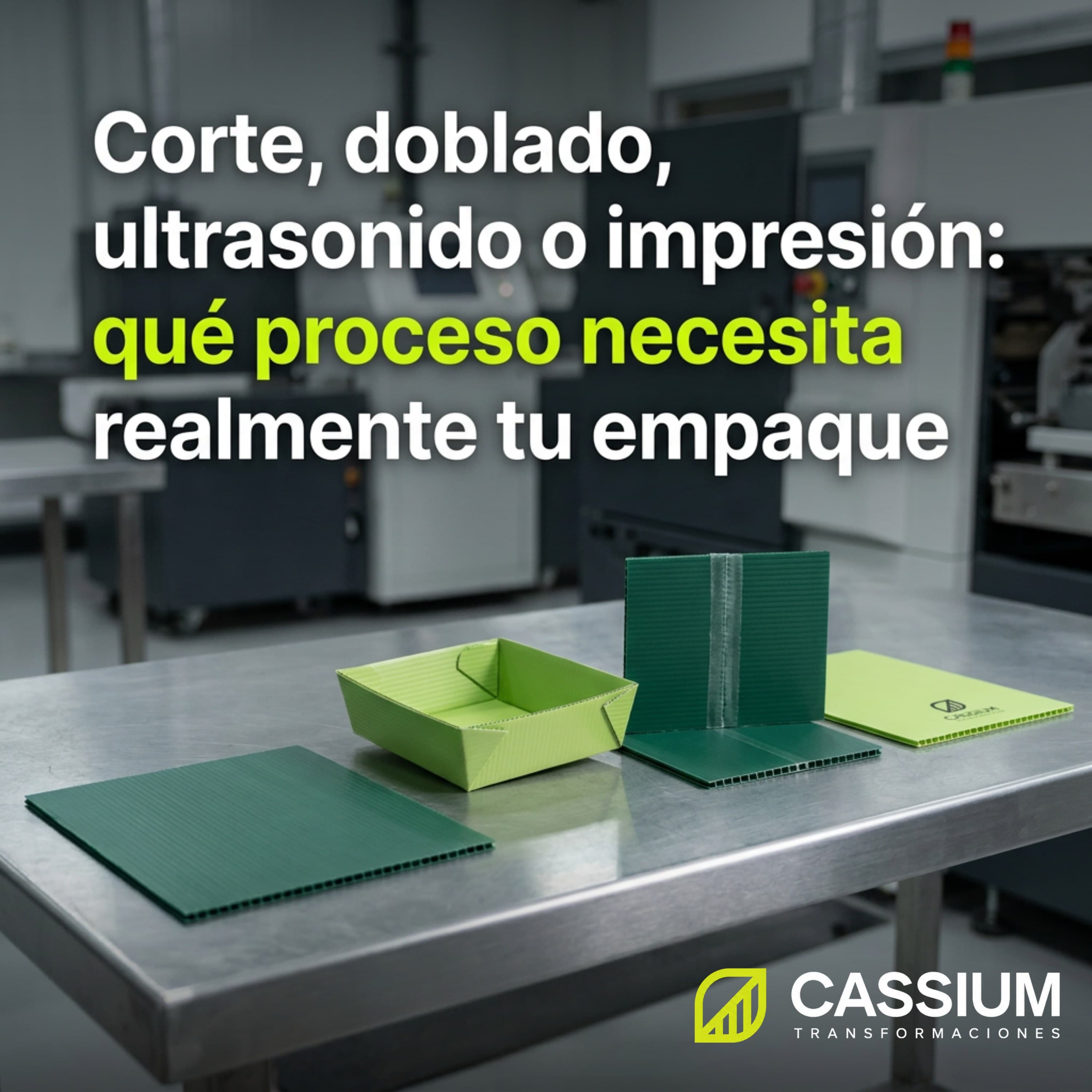
Each process solves a different problem: cutting and folding define the box's geometry, ultrasonic welding seals the joints under the most stress, and printing provides functional identification, not just aesthetics.
When Imprecise Cutting Ruins the Assembly Before the Box Reaches Your Line
Cassium Transformaciones manufactures returnable boxes, trays, dividers, custom dunnage separators, POP material, and displays from its own corrugated sheet in Monterrey. Each of these pieces goes through a different combination of the four processes, depending on the function it serves in your operation. Understanding what each process solves is what lets you pay for exactly what your piece needs, with no charges for finishes that don't add performance where it's used.
Cutting Tolerances and Score Lines: The Difference Between a Clean Fold and an Out-of-Square Box
Cutting determines the exact geometry of each piece: the length, the width, and the position of each score line that later defines where the material folds. A wide cutting tolerance produces pieces that vary from one to the next within the same lot, and that variation turns into boxes that don't close the same way, trays that don't fit the same rack, and dividers that sit loose inside the box. In automotive and electronics, where assembly depends on every component landing in the exact position inside the packaging, that variation turns into manual adjustment time on the line, the cost nobody quotes but that gets paid anyway.
In a supplier audit, the first indicator that flags imprecise cutting is weight variation between pieces in the same lot: two boxes that should weigh the same, using the same amount of material, end up with different weights because the die left burrs or the cut didn't follow the specified tolerance. That variation, which looks minor on a single piece, multiplies when the order is thousands of units and ends up affecting the yield of the material bought to produce them.
Folding depends directly on how precise the preceding cut was. A poorly calibrated score line forces the operator to force the fold, and that extra effort weakens the corrugated fiber exactly where the box needs the most structural strength: the corner. That's why cutting and folding are quoted together in most projects: it doesn't make sense to evaluate one without the other, because the second inherits the precision or the error of the first.
For logistics, this sequence also determines lead time. An order that combines cutting, folding, and ultrasonic welding on the same piece requires a different production route than an order that only needs cutting and folding, and scheduling that route from the start keeps an urgent run from getting delayed by processes that could have run in parallel if they'd been quoted separately from the beginning.
The Process That Decides Whether a Dunnage Separator Survives Transport Vibration Without Coming Apart
Ultrasonic Welding: Why It Replaces Adhesive and Staples in High-Stress Pieces
Ultrasonic welding fuses the corrugated material at the joint line using high-frequency vibration, with no adhesive or metal staple required. That welded joint withstands compression and vibration during transport better than a glued joint, which can peel apart under humidity or heat, or a stapled joint, which introduces a metal point inside the packaging. In batteries and electronics, that metal point is an electrostatic discharge risk no specification can afford. In food, beverage, and pharma, it's a physical contamination risk inside the production area.
Not every piece needs ultrasonic welding. A lightweight, low-rotation tray can be handled with a simple fold and a less demanding joint, while a dunnage separator custom-built for a high-value automotive part, one that's going to travel dozens of times within the same closed loop, needs a joint that won't give out on any cycle. Quoting ultrasonic welding across the entire piece when only one area requires it inflates the cost without adding strength where it isn't needed.
Pairing ultrasonic welding with the right material variant also solves a problem adhesive can't: compatibility with sanitization processes. In food and beverage, a glued joint exposed to frequent washing loses its bond before reaching the projected cycles, while a welded joint keeps its strength because the material fused with itself at the joint, with no third component that reacts to water or detergent.
When Printing Stops Being Cosmetic and Becomes Mandatory Traceability
UV Printing and Corporate Color: Functional Identification Inside a Closed Loop
In a closed loop where the same returnable circulates between your plant, your supplier, and sometimes a sister plant, printing serves a traceability function: it identifies which line the box belongs to, keeps it from getting mixed up with another supplier's packaging in the same staging yard, and makes counting easier during a returnable packaging inventory audit. Corporate color serves the same function at a distance, before the operator even has to read a label.
Cassium Transformaciones prints with UV technology, a process that cures the ink with ultraviolet light instead of letting it air-dry. UV-cured ink withstands the friction of repeated handling and exposure to moisture better than conventional printing, which matters on packaging expected to last up to 40 cycles, not a single run. Without that level of durability, the identification fades before the box reaches the end of its service life, and the closed loop loses the traceability it paid for when it was printed.
The same logic applies to the POP material and displays Cassium Transformaciones manufactures for point of sale. There, printing serves a brand image function for the end consumer more than internal traceability, which is why corporate color and UV finish become part of the piece's design, not an optional extra.
The four processes (cutting, folding, ultrasonic welding, and printing) are quoted separately because each solves a different function within the same piece, not because they compete with each other. The right combination depends on the application: load weight, rotation frequency, regulated sector, and whether the packaging needs a UV, ESD, or corporate color variant. Cassium Transformaciones manufactures from its own corrugated sheet in Monterrey, under ISO 9001:2015, which allows each process to be adjusted to your operation's real specification instead of applying the same process package to every order.
For the quality buyer, traceability of these processes is also a documentation matter. Under ISO 9001:2015, every returnable production run has to be able to show which process was applied to which lot and under what control parameter. Cassium Transformaciones documents that relationship from its plant in Monterrey, which makes the audit easier when your own customer asks for evidence of process control over the packaging they receive.