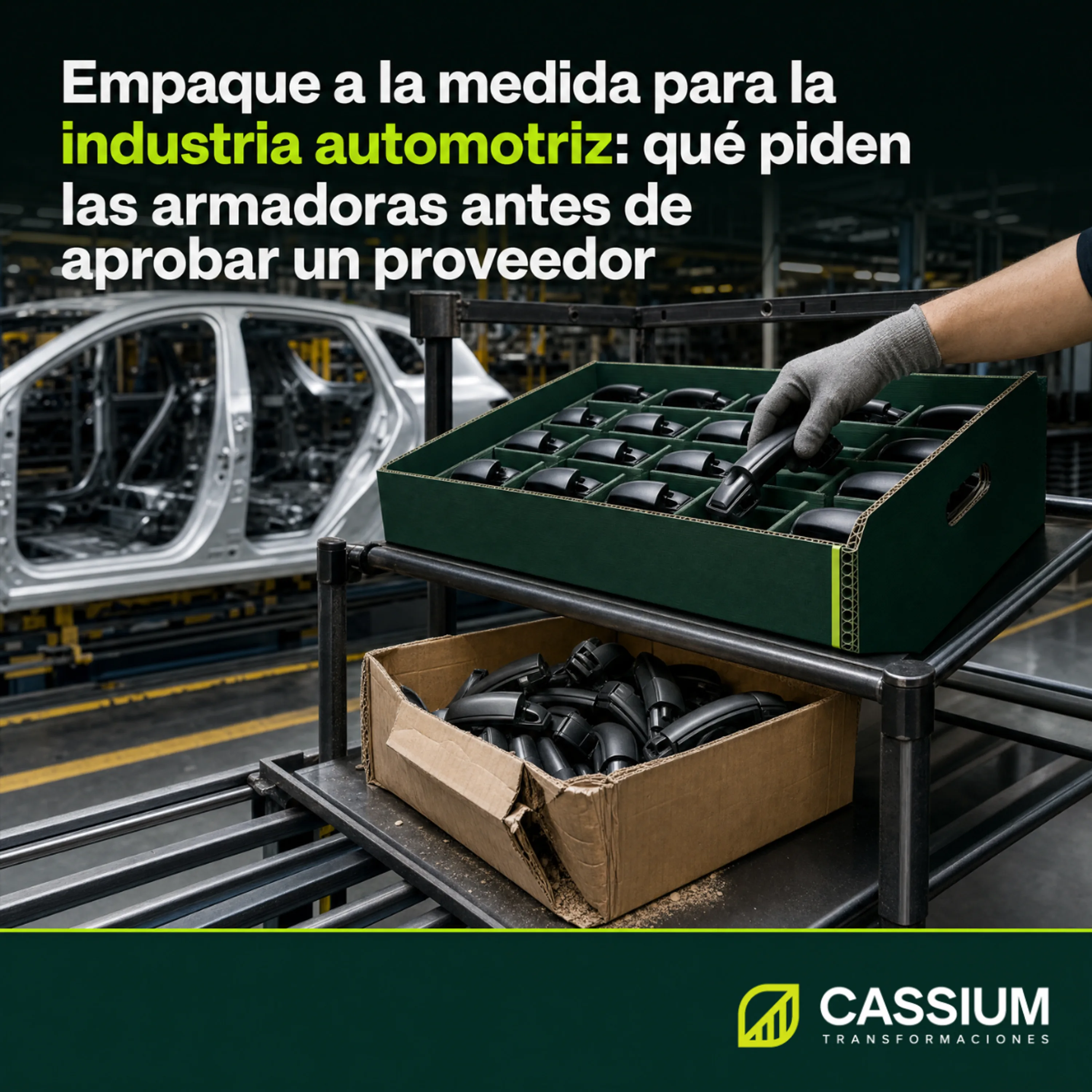
Before approving a supplier, the OEM or Tier 1 validates the packaging with the real part: Class A surface protection, transport testing, fit on its line, ergonomics, identification and a documented approval file.
Why packaging can hold up approval of a part that has already passed every test
In the automotive industry, the part and its packaging are approved as a set. The Production Part Approval Process (PPAP) requires the supplier to demonstrate that it manufactures the part consistently, and each OEM's customer-specific requirements usually add a packaging section: how the part travels, how many go in each container, how they are identified and how they reach the line. A Tier 1 passes those same requirements on to its own suppliers, so the demand flows down the entire chain.
The reason is operational. The OEM's assembly line is designed around the container that arrives: the space on the rack, the height at which the operator picks the part, the quantity consumed in each replenishment cycle and the refill frequency. Packaging that does not fit that design forces someone to rearrange the part at the station, and that extra movement turns into cycle time, risk of damage and one more point where the part can fall.
The packaging specification sheet: the document approved together with the part
Most OEMs and Tier 1 suppliers work with their own packaging specification form, which the supplier fills out and the customer approves before launch. It normally includes the container type, its outside dimensions, its empty and full weight, the number of parts per container, the maximum stack height, a photo of the packed part and the type of interior that holds it. Once approved, that sheet becomes the standard: any change to the packaging requires a new revision and a new approval, just like a change to the part.
The test that shows whether your packaging protects the part or simply rides along with it
An automotive customer approves packaging after seeing it with the real part inside and, in many cases, asks for evidence that the part arrives undamaged after traveling the actual route or a laboratory test that simulates it.
Validation with the real part: the fit the drawing cannot prove
The drawing defines the part's nominal geometry, but a production part comes with process variation, clips already installed, flash or a curvature the model does not fully capture. That is why the first step is to test the interior with real parts: each one should go in without force, move no more than planned and come out without touching the sensitive surface. We have explained in another article why the drawing is not enough to quote dunnage; what matters here is that the OEM's engineer will repeat that test with their own part before signing off.
Vibration, drop and compression before the first shipment
The second piece of evidence covers transport. Typical tests subject the full container to vibration that simulates the truck route, to drops and impacts that simulate forklift handling and to compression that simulates stacking in the warehouse and in the trailer. There are protocols recognized by the packaging industry, such as those from ISTA and ASTM, and some OEMs have their own. A trial shipment over the actual route, with every part inspected on arrival, is also used. Both require a prototype that faithfully matches the final design.
Class A surfaces: the defect the OEM spots first and tolerates least
A Class A surface is the one the end customer sees: the outer face of a fascia, a molding, an instrument panel, a mirror housing or a painted handle. On those surfaces, a scratch that would go unnoticed on another part is grounds for rejection, and the OEM finds it during receiving inspection or, worse, with the part already installed on the vehicle.
Allowed contact zones: where the part can rest
Designing the interior starts with a map of the part: which faces are Class A and must stay free of any contact, and which zones (mounting tabs, inner edges, faces that will be hidden in the vehicle) can serve as support. The dunnage separator is designed so the part rests only on those zones and stays apart from its neighbors, the walls and the bottom. We have described in another article how a generic separator scratches painted parts; with an OEM, that contact map is also documented with photos of the part in its cell.
Clean material: no fiber, no dust and no abrasive edges
The interior material is evaluated too. Cardboard sheds fiber and dust with every handling, and many plants restrict it near their paint areas because any particle on the surface ends up as a finish defect. Corrugated polypropylene sheds no fiber, cleans with water and keeps its edges firm after many cycles, which keeps the level of protection stable throughout the life of the fleet.
When the container reaches the line and the operator cannot get the part out
Protection covers half of the requirement. The other half is making sure the packaging works where the part is consumed, and that is where the customer's internal logistics and ergonomics teams come in.
Line-side flow: rack dimensions, orientation and quantity per container
OEMs feed their lines with flow racks, carts or supermarkets that accept containers of defined dimensions. The packaging must fit that space, present the part in the orientation in which the operator or the robot picks it and hold a quantity that matches the line's replenishment logic, usually defined by the customer's kanban system. A container that forces the operator to turn the part before installing it adds seconds to every cycle, and on a high-volume line those seconds add up by the end of the shift.
Ergonomics: weight, reach and pick height
The ergonomics team reviews the weight of the full container when it is handled manually and the distance the operator must reach to pick the last part. Each OEM sets its own limits. A deep container with parts arranged in several layers can be efficient for freight and a problem for the operator; in those cases, tiered trays, handholds cut into the sheet or a smaller quantity per container meet the requirement without changing material.
Identification that can be read at the dock and on the line
Each container carries the shipping label in the format defined by the customer's supplier manual, usually with a barcode, part number, quantity and supplier data. Returnable packaging adds a layer of its own: sheet color and direct printing make it possible to dedicate containers to a part number or a customer, and a well-placed label holder keeps the label from peeling off or being hidden in the stack.
The file your customer asks for before signing the approval
These are the documents worth having ready before your customer's packaging engineering visit:
- Drawing of the container and its interiors, with revision number and approval date.
- Packaging specification sheet in the customer's format, with dimensions, weights, quantity per container and maximum stack height.
- Photos of the packed part, the full container and the complete stack.
- Results of the transport test or trial shipment, with the acceptance criterion that was used.
- Material data sheet and the quality management system certificate of the packaging manufacturer.
Change control: approved packaging is frozen
Once approved, the packaging is frozen: its gauge, material, dimensions and manufacturer stay the same, and any change is reported to the customer to obtain a new approval. That is why it matters who makes it. At Cassium Transformaciones we extrude our own sheet in Monterrey and convert it at the same plant, under an ISO 9001:2015 certified quality management system, so every change in the material or the process goes through a single manufacturer that can give you notice in time.
We design dunnage separators, trays and returnable containers for automotive parts based on the real part, with cutting, folding, ultrasonic welding, printing and antistatic sheet when the part includes electronics. We deliver a prototype so your team and your customer can validate it with the production part, we adjust the design based on their feedback and we give you the technical information your approval file needs.
If your next launch still has no packaging defined, that is the part of the approval file that can stop your part from being approved. At Cassium Transformaciones we design the packaging around your real part, with a prototype to validate it together with your customer and the technical documentation your file requires. Tell us about your program at https://transformaciones.cassium.com.mx/en