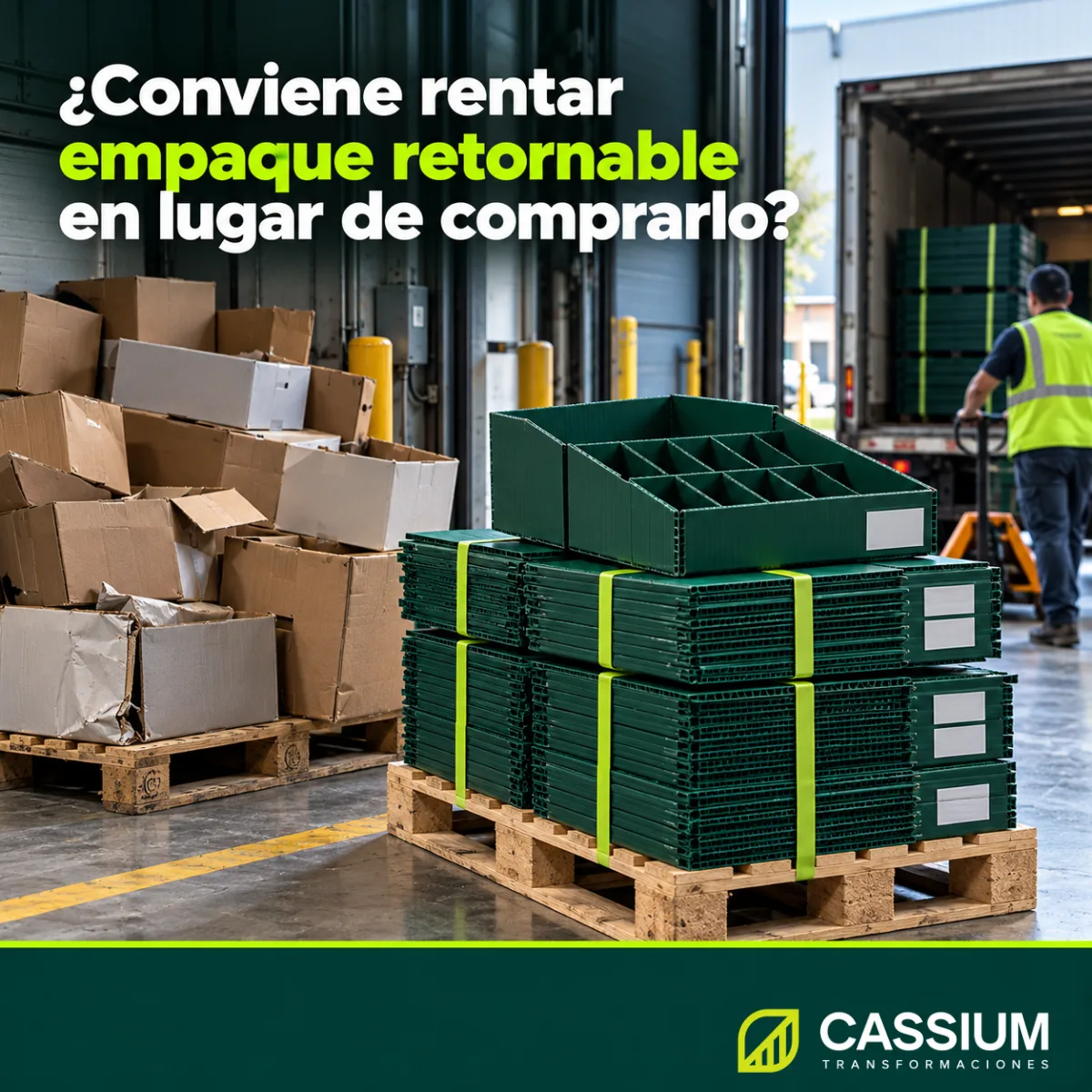
Renting makes sense in open loops, with temporary demand and parts that fit well in a standard box. Buying makes sense on closed, stable routes, with parts that call for custom packaging and many cycles per box.
Why the rental bill can grow faster than your operation
Renting returnable packaging turns an investment into an operating expense. Instead of buying the fleet, you pay to use it, and the program provider handles delivering, collecting and replacing boxes under its contract. For many companies, that is the fastest way to move off cardboard without requesting capital budget.
The risk is that the expense grows with every variable in your loop. More trips, more destinations, more dwell days or more losses translate into a higher bill, and those variables rarely stay put when the operation grows.
Per trip, per day or per box: what sets the rate
Each rental program charges under its own scheme. Some contracts charge per trip, others per day of use and others combine a fixed rate per box with movement charges. Before comparing, translate any proposal into a single number: how much you pay for each complete trip of a box, from the moment it leaves your plant until it is available again.
Retention, loss and damage charges
Rental contracts include charges when a box spends more days than agreed at a destination, when it is lost or when it comes back damaged. These charges are reasonable from the fleet owner's point of view, and even so they are the ones that pull the real bill furthest from the initial proposal. If your customers hold on to boxes or use them for other purposes, you pay those charges.
What to ask before you sign
A rental proposal is evaluated by its full contract. Before you sign, get these answers in writing:
- How many dwell days the rate includes and how much each additional day costs.
- What happens to a box your customer fails to return and who pays to replace it.
- What counts as damage and who determines it.
- How far in advance extra boxes must be requested for a demand peak.
- What the minimum contract term is and what it costs to end it early.
When renting makes sense
As manufacturers of returnable packaging, it is in our interest for you to buy the fleet from us. Even so, there are operations where renting is the best decision, and we tell you so clearly.
Open loops, with destinations that do not return boxes on their own
If your boxes reach many different destinations, without fixed return routes, collecting them yourself can cost more than the packaging itself. In that scenario, a rental program with a collection network handles the return logistics your company lacks.
Seasonal peaks and projects with an end date
A peak lasting a few weeks or a project lasting a few months leaves an owned fleet idle the rest of the year. Renting covers the peak without leaving idle boxes in your warehouse when demand drops.
Parts a standard box protects well
Renting works best when your part travels safely in a catalog box, without filler or adaptations. If the program's standard box protects your product, the main drawback of renting disappears.
Without a capital budget for the fleet
If your company needs to move off cardboard this year and the investment budget is already committed, renting lets you launch returnable packaging without waiting for the next budget cycle. In that case, it makes sense to revisit the decision once the loop has a full year of data.
When buying your own fleet comes out ahead
Buying requires an upfront investment and responsibilities that renting takes off your hands. In return, in certain operations the cost per trip drops with every cycle and the packaging adapts completely to your part.
Closed, stable routes
In a closed loop, boxes go to the same destinations and come back to your plant along the same route. There, collection is already part of your logistics, and the cost of an owned box is spread across all the trips it completes. A box designed to reach up to 40 uses spreads its price across many cycles, while rental charges for each trip separately.
Parts that call for custom packaging
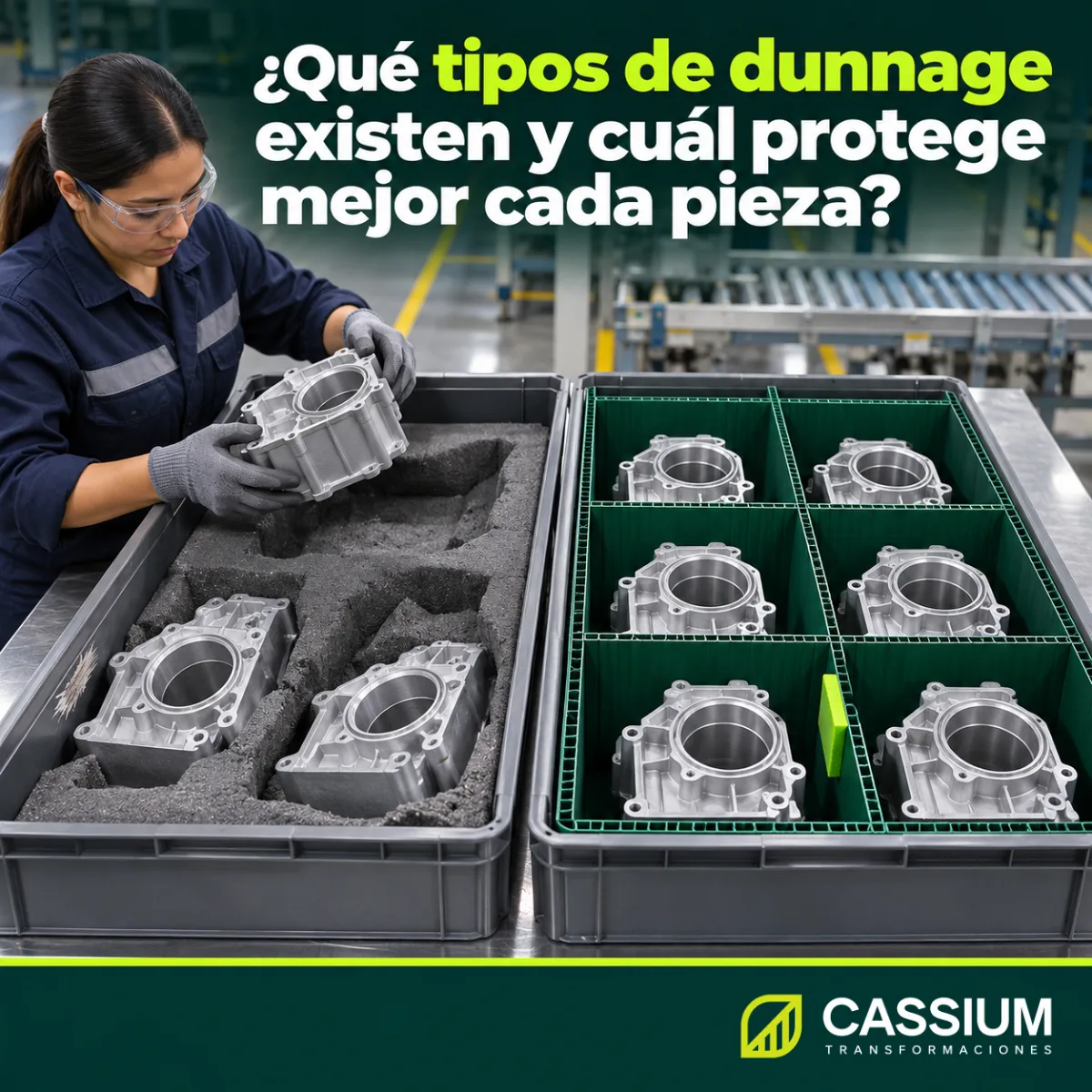
If your part needs dividers, dunnage separators, trays with cavities or antistatic protection, a catalog box only half protects it. The disposable filler that makes up the difference is bought on every trip and cancels out part of the savings of returnable packaging. Custom packaging holds the part in place from the design stage and eliminates that consumable.
Your own identification and fleet control
With an owned fleet, the box can carry your corporate color, your logo and sequential numbering printed during manufacturing. That identification makes reconciliation with each customer easier and makes it clear who owns each box on any dock.
A horizon of several years
If your customer's program will last for years, every month of rent adds to an expense that never becomes an asset. With an owned fleet, the cost is concentrated at the start, and after that you only pay for replacement, control and return logistics.
What you buy along with the boxes
Buying the fleet also means taking on tasks that the program provider handles in a rental. It makes sense to include them in the numbers from the start.
Fleet control and reconciliation with customers
An owned fleet needs someone in charge, an inventory by location and periodic reconciliation with each customer. Without that control, boxes stay on destination docks and your company ends up replacing early what is actually on loan.
Collection, cleaning and replacement
Collection, cleaning between cycles and replacement of write-offs become your responsibility. In a closed loop, collection rides on the trucks that already run the route; in an open loop, it becomes a cost of its own that can tip the balance toward renting.
Space for empty boxes
Empty boxes take up space at your plant while they wait for the next fill. An owned fleet needs a defined area for them, and a collapsible box reduces that space and the space on the return truck. If your warehouse is already at its limit, include it in the evaluation.
The calculation that decides: cost per trip over the project horizon
Comparing the monthly rental rate with the price of a new box leads to the wrong conclusions. The useful comparison is the cost per trip of each option over the full life of the project, with all its components. Gather this data:
- Trips per box per month and dwell days at each destination.
- Rental rate per trip, with retention, loss and damage charges.
- Filler or consumables that the program's standard box requires.
- Price of the custom box and the number of cycles you expect from it.
- Cost of control, collection, cleaning and replacement for the owned fleet.
- Expected length of the program with your customer.
Divide the total cost of each option by the trips you expect over that horizon. The option with the lowest cost per trip, with the part well protected, is the one to choose.
Mixed approaches: an owned fleet plus peak coverage
The decision can be a combination. An owned custom fleet covers the stable volume of your loop, and the peak season is covered with rental or temporary packaging. Renting during the first months also helps you measure the real cycle, the dwell time at each destination and the losses, and then size your own fleet with data.
At Cassium Transformaciones we extrude our own corrugated polypropylene sheet and manufacture boxes, containers, trays and dunnage separators at the same plant in Monterrey, under an ISO 9001:2015 certified quality management system. We design packaging around your part, with a prototype before the fleet, identification printed during manufacturing and boxes designed to reach up to 40 uses. We produce replacement boxes from the same drawing as the original fleet, without import lead times.
If your rental bill grows every month and your boxes travel with filler, it is worth running the cost-per-trip numbers for an owned fleet. At Cassium Transformaciones we design and manufacture your custom returnable packaging in Monterrey, with a prototype before the fleet. Tell us how your packaging moves on our contact page.