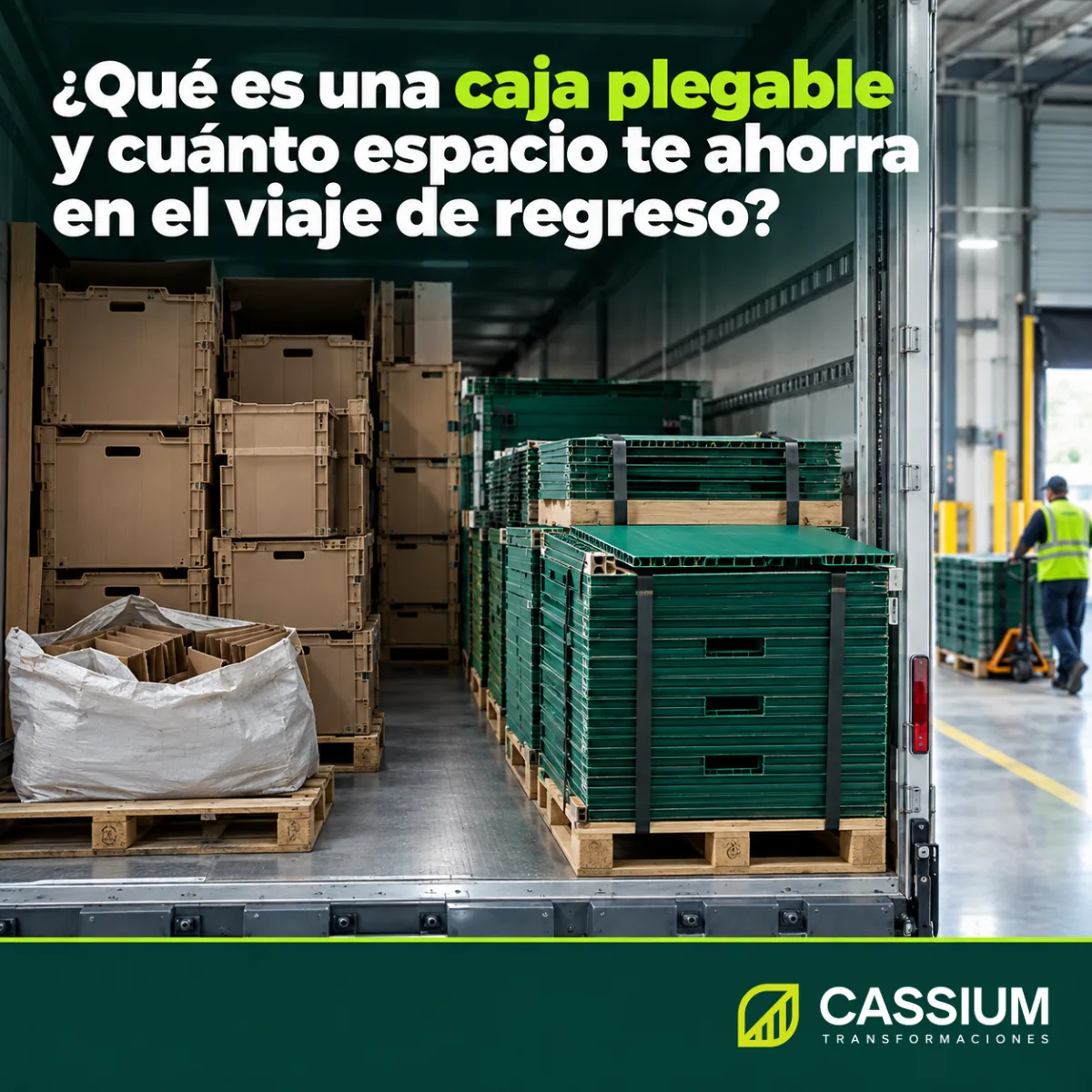
A collapsible box is a returnable box whose walls fold onto the base when it is empty. Its savings are calculated with the actual folded height, per pallet and per truck, and they depend on the box coming back folded.
What a collapsible box is and why its job starts when it is empty
A collapsible box is a returnable box made of corrugated polypropylene sheet, formed by a base and walls joined by scores that work as hinges. When it is full, the walls are raised and secured with flaps, tabs or closures designed into the same die. When it is emptied, the walls fold down onto the base and the box becomes a flat package a few centimeters high.
We have already compared in another article when a collapsible container pays off over a rigid one. Here we assume your operation has already chosen the collapsible option, or is evaluating it, and we look at the leg that justifies its design: the return trip.
Reverse logistics for empties: the leg your operation usually pays for
On the outbound trip, freight is part of the sales price. On the return, the box travels empty and, unless your agreement with your customer says otherwise, your operation pays for that leg. Reverse packaging logistics includes the time empties wait on your customer's dock, loading, transit and unloading at your plant, and at each point the box takes up the space its shape gives it: assembled or folded.
The empties truck fills up by volume and travels at a fraction of its weight capacity
An empty corrugated polypropylene box weighs little, so the return truck almost never reaches its load limit. What runs out first is the floor pallet positions and the clear height of the vehicle. That is why empty-return freight is sized by cube: how many boxes fit in the available volume.
Cost per returned box: the figure worth measuring
The most useful indicator for the return trip is the cost per returned box: the cost of each empties trip divided by the boxes it brings back. Since a truck costs practically the same with few boxes or many, every additional box on the same trip makes all the others cheaper. To get this figure, simply record for a few weeks how many boxes each pickup brings back and what it cost.
How to calculate the space a folded box takes up compared with an assembled one
The calculation is done at three levels: the box, the pallet and the truck. Skipping one is the most common way to promise savings that never show up.
Actual folded height: measure it with a stack of boxes
The assembled height is on the drawing. The folded height depends on the sheet gauge, how many walls end up on top of each other, the closures and the memory of the scores, which keeps the folded wall from lying perfectly flat. That is why it is measured with the prototype: fold ten boxes, stack them the way they will travel and divide the height of the stack by ten. That average is the figure that goes into the calculation.
Boxes per layer and layers per pallet
On the pallet, you calculate how many boxes fit per layer, based on the box footprint and the pallet size, and how many layers fit in the available height. Assembled, each layer is as tall as the box; folded, it is as tall as the folded height. Check that the folded box keeps the footprint of the base, because if a wall sticks out, the number of boxes per layer changes.
From the pallet to the truck positions
The last level multiplies the boxes per pallet by the truck's pallet positions. This is where constraints unrelated to the box come in: the maximum height of the vehicle, whether your carrier allows double stacking pallets and the height that can be moved by forklift without losing stability. A stack of folded boxes travels steadily when it is strapped or stretch wrapped; loose, it slides at the first hard brake.
A calculation example, step by step
The following numbers are an illustrative example, only to show how the math works; yours come from your box, your pallet and your transportation. Suppose a box with a 60 × 50 cm footprint and an assembled height of 35 cm, a 120 × 100 cm pallet with 175 cm of available height for the boxes and a truck with 20 pallet positions, without double stacking.
- Boxes per layer: on a 120 × 100 cm pallet, two boxes fit lengthwise and two across, for 4 boxes per layer, assembled or folded.
- Assembled box: 175 cm divided by 35 cm gives 5 layers, or 20 boxes per pallet.
- Folded box: if the test stack came out at 7 cm per box, 175 cm divided by 7 cm gives 25 layers, or 100 boxes per pallet.
- Full truck: 20 pallets of assembled boxes carry 400 boxes; 20 pallets of folded boxes carry 2,000.
In this example, each pallet and each truck carry five times as many folded boxes as assembled ones, and the cost per returned box drops to one fifth. If your customer empties 1,200 boxes a week, assembled they need 3 full trips; folded, they fit on 12 pallets in a single trip, with room to spare on the truck. The difference also shows on your customer's dock: 1,200 assembled boxes take up 60 pallet positions, and folded they take up 12.
The math changes with every input. If the dividers come back inside the folded box, the stack gets taller and the calculation is repeated with the new measurement; if they travel separately, their pallets are added as well. And if some of the boxes come back assembled, the savings drop fast: if half of the 1,200 boxes come back assembled, those 600 take up 30 pallets, the 600 folded ones take up 6 and the return needs two trips again.
Why the calculated savings do not reach the return truck
What the calculation promises depends on what people do on your customer's dock. These are the three points where the savings are most often lost.
Boxes that come back assembled
Folding one box takes seconds, but hundreds of boxes at the end of a shift are a task nobody has been assigned. If the agreement with your customer does not say who folds the boxes, where and when, they get stacked assembled next to the line and go onto the truck that way. Folding at the same point where the box is emptied works better, with a visual instruction of a few steps and a return pallet already placed there.
Poorly built return pallets
A return pallet delivers the calculated yield when it carries a single box model, folded in the same orientation, up to the defined height and secured with strapping or film. Assembled boxes mixed with folded ones prevent even stacking, different models on the same pallet waste footprint and a half-height pallet takes up a full truck position with half the boxes.
Interiors that travel on their own
Dunnage dividers and trays come back too. If the design allows them to fold together with the box, they travel inside and the folded height already includes them. If they are removed, they need their own return pallet, because loose in bags or sacks they get damaged, get lost and take up more space than planned. It is worth defining this in the design, because it changes the folded height and the dock procedure.
Fewer trips or more frequent pickups: what you do with the space you free up
The space that folding frees up has two possible uses: consolidating the week's empties into fewer trips, or bringing them back more often without paying for half-empty trucks. The second option shortens the wait on your customer's dock and, with it, the cycle of each box and the fleet you need; we have already explained in another article how to calculate that fleet. Spacing out pickups to fill the truck has the opposite effect and forces you to keep more boxes in circulation.
What the design decides about the return trip
Folded height, footprint and folding time are decided in the design. The gauge and grammage of the sheet, the placement of the scores and the type of closure define how tall the folded box is; the way the walls fold down defines whether it keeps its footprint; and a sequence of a few steps, with no loose parts, defines whether your customer's operator folds it. A tab that keeps the box closed prevents the stack from opening on the pallet, and identification that stays visible when the box is folded lets you count it without breaking down the stack.
At Cassium Transformaciones we extrude our own corrugated polypropylene sheet and convert it at the same plant in Monterrey, under an ISO 9001:2015 certified quality management system, with cutting, scoring, ultrasonic welding and printing. Before we manufacture the fleet, we deliver a prototype so you can fold it, stack it and measure the stack on your actual pallet, and we design each box to reach up to 40 uses with normal handling in your loop.
If your return truck still leaves full of boxes that could have come back folded, the savings from the collapsible box are staying on your customer's dock. At Cassium Transformaciones we design the collapsible box around your pallet, your truck and your return procedure, with a prototype to measure the savings before we manufacture the fleet. Tell us how your empties come back at https://transformaciones.cassium.com.mx/en