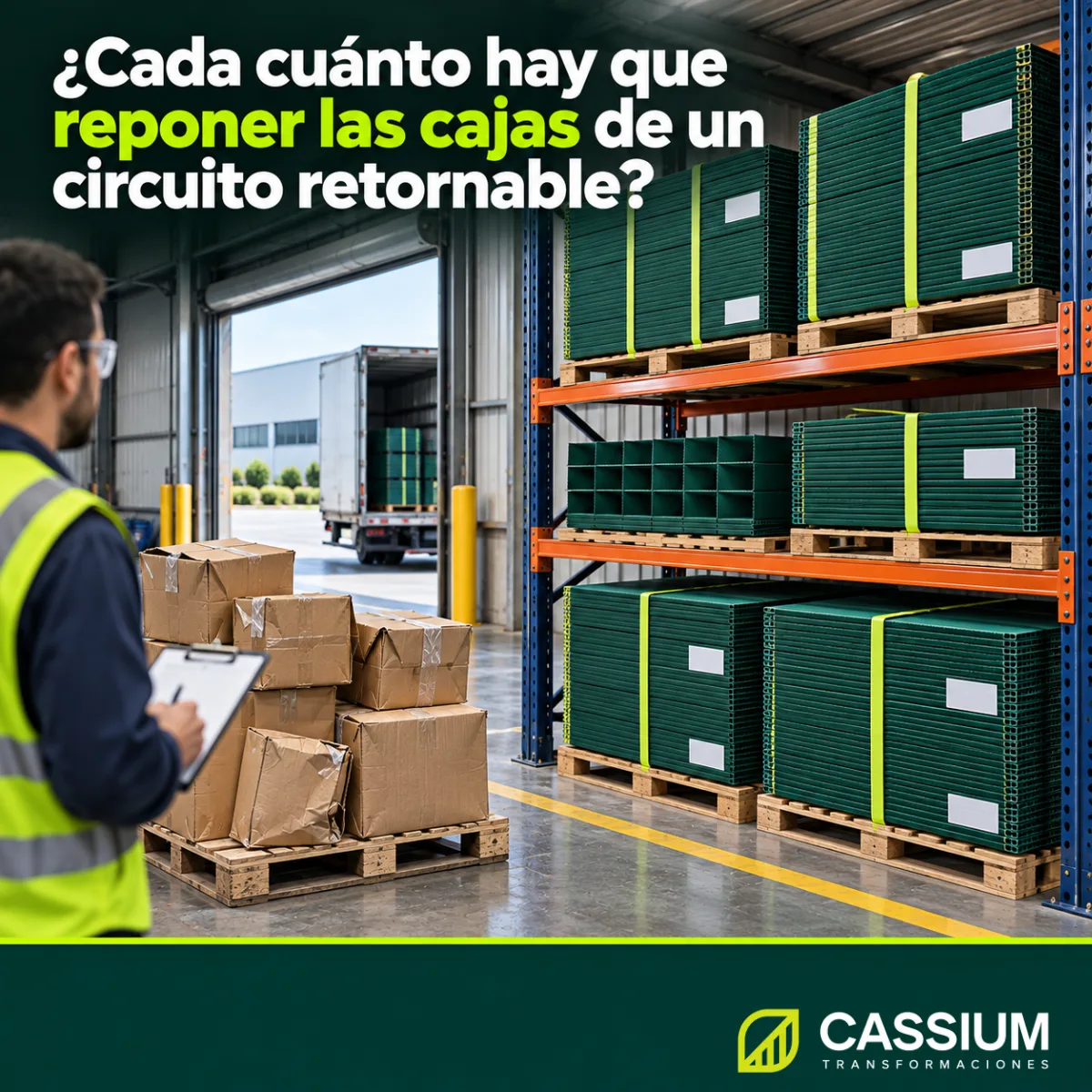
Boxes in a returnable loop are replaced according to their replacement rate. That rate adds up losses, damage write-offs and wear, and it lets you schedule a periodic purchase and a reserve that prevents stoppages.
Why a fleet that is complete on day one runs short without anyone noticing
Calculating the returnable box count for a loop covers the startup. What defines the following years is replacement, because a returnable fleet loses boxes from the first month and loses them for different reasons, each with its own pace. If nobody measures that pace, the fleet shrinks quietly until the line runs out of packaging.
The four ways boxes leave a returnable fleet
A box leaves the loop through loss, when it stays on a dock, in a truck or at a plant that used it for something else. It leaves through damage, when a forklift hit crushes a corner or a wall cracks. It leaves through wear, when the hinge, the lid or the divider reaches the end of its life after many cycles. And it leaves through a part change, when the product it carried changes shape or size and the box no longer fits it.
The wear that advances even when nothing breaks
A corrugated polypropylene box designed for the loop reaches dozens of uses with normal handling. That number is a service life, and every service life ends. In a fleet that started complete in a single purchase, all the boxes age at the same time, and wear shows up all at once: one quarter with no write-offs and the next with a share of the fleet out of service. Planning replacement avoids that step.
How to measure your loop's replacement rate
The replacement rate is the percentage of the fleet that leaves the loop in a period, for any of the four causes. It is the figure that turns replacement into a purchasing program instead of an emergency.
Counting entries and write-offs
It all starts with a simple record: how many boxes entered the fleet, on what date and with what identification, and how many were written off, when and for what cause. With box-level identification, the record is kept with a scanner at the empty-box receiving station; without it, with a monthly count of the whole fleet. What matters is separating the cause of each write-off, because loss and damage are corrected in different ways.
Separating loss from damage
A lost box is a loop control problem: incomplete returns, boxes diverted to other uses, reconciliation nobody does with the customer. A damaged box is a handling or design problem: forklifts hitting the stack, a gauge too light for the number of stacking levels, hinges that split before the expected cycles. If the replacement rate lumps both causes into a single number, the purchase gets planned well and the loop keeps losing boxes for the same reason.
Turning the rate into boxes per period
With three or four months of records, the replacement rate becomes stable and can be projected. If the fleet loses a certain percentage per quarter across all causes, that number of boxes is what you want manufactured before the quarter ends. The calculation is adjusted when the route changes, when a new customer joins the loop or when volume rises, because each of those changes moves the rate.
The replacement reserve that keeps you out of emergency cardboard
Between spotting the box shortage and receiving the new order, weeks of manufacturing and delivery go by. The replacement reserve covers that gap so the line never ships in emergency packaging.
How much reserve to keep
The reserve is sized with two figures: the replacement rate and the time your supplier takes to manufacture and deliver. If the fleet loses a certain number of boxes a month and manufacturing a lot takes several weeks, the reserve has to cover the write-offs for that period plus a margin for the seasonal peak. A reserve that is too small runs out before the lot arrives; one that is too large ties up capital and takes space in the empty-box warehouse.
Spare parts instead of whole boxes
Part of the wear-related write-offs can be avoided with spare parts. A broken divider, a lost lid or an illegible label are replaced by component, and the box stays in circulation. When the fleet design includes interchangeable dividers and separators, the reserve is made up of inexpensive spare parts and fewer whole boxes, and the cost of keeping the fleet running drops noticeably.
Where the reserve lives
The reserve is kept indoors, clean and folded, on a rack separate from the boxes in circulation. If it mixes with the active fleet, it gets used without control and stops being a reserve. The person in charge of the fleet authorizes each box that moves from the reserve into the loop, and that move is recorded as an entry.
How to plan the purchase so your supplier manufactures on time
Replacement works better as a program with dates than as one-off orders. A supplier who knows your calendar reserves material and capacity and delivers the lot before the reserve runs out.
Periodic lots from the same drawing
Each replacement lot is made from the same drawing, the same gauge and the same printing as the original fleet, so the new boxes sit alongside the old ones in the same stack and on the same rack. If the design changed for an improvement, define the lot where the change starts and how the two versions are identified, so the customer receives boxes that behave the same.
Staggered replacement versus aging as a block
A fleet bought all at once ages as a block. When replacement is done in periodic lots, boxes of different ages mix and wear spreads across the year instead of piling up in one quarter. After two or three replacement cycles, the fleet has new boxes, mid-life boxes and boxes close to retirement, and each period's purchase becomes nearly constant.
When to renew instead of replace
If the wear-related replacement rate rises steadily and the fleet goes past the cycles it was designed for, replacing box by box stops paying off. At that point, renewal of the whole fleet is planned in stages, with a design that corrects what the record showed: a hinge that failed early, a gauge too light for the real stacking or a divider that could not withstand the part.
Signs that replacement is running late
These are the signs we see most often in loops that come to us asking for boxes urgently:
- Shipments going out in cardboard or in boxes from another line because returnables are missing.
- Boxes with split hinges or broken dividers still in use for lack of a replacement.
- Nobody knows how many boxes are in circulation or how many sit on customers' docks.
- The last box purchase used the startup quantity, with no record of write-offs.
- The supplier receives the order when the reserve has already run out and the line is waiting for the lot.
Each one is fixed with the same tool: a record of entries and write-offs by cause, a measured replacement rate and a purchase scheduled with your supplier.
What we need to schedule your replacement
To set up a replacement program with you, we ask for this information from the first conversation:
- The current fleet size and the date of its last purchase.
- Write-offs in the last period, separated into loss, damage, wear and part change.
- The average cycles each box has run and the cycles you expect from it.
- The current box drawing and the changes you want to include.
- Your operation's peak calendar and the lead time you need.
At Cassium Transformaciones we extrude our own corrugated polypropylene sheet and make boxes, containers, trays and dividers at the same plant in Monterrey, under an ISO 9001:2015 certified quality management system. We design each returnable box to reach up to 40 uses with the normal handling of your loop, we make replacement lots from the same drawing and with the same printing, and we supply dividers and separators as spare parts so you replace components instead of whole boxes.
If today you don't know how many boxes your loop loses each month or when your next lot arrives, the next packaging emergency already has a date. At Cassium Transformaciones we manufacture your custom returnable packaging in Monterrey and schedule replacement lots and spare parts with you from the same drawing. Tell us how your fleet is doing on our contact page.