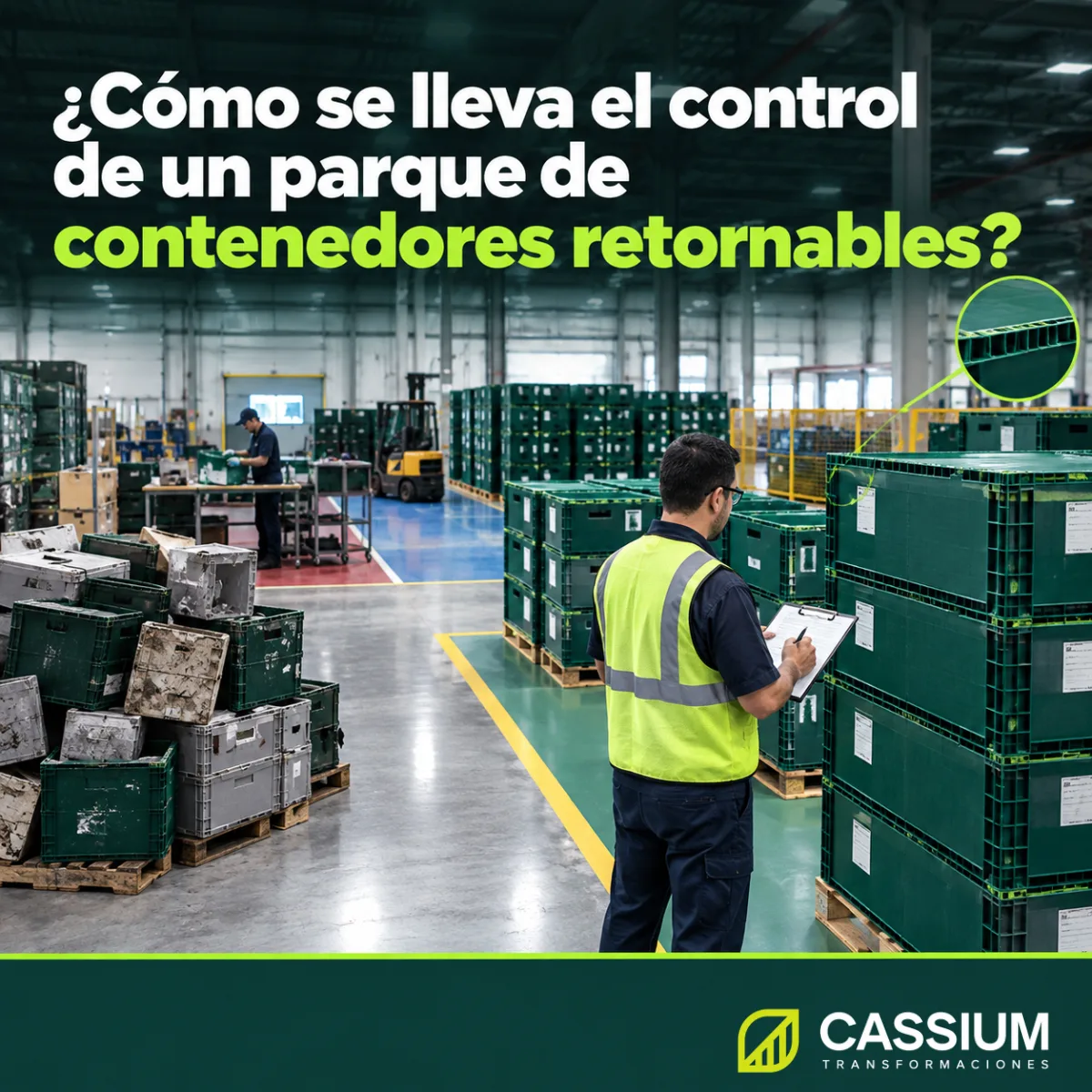
A returnable fleet is controlled like any other inventory: every box recorded at a location, every movement backed by a document, balances reconciled with customers and suppliers, approved write-offs and indicators reviewed every week.
Why an uncontrolled fleet gets lost even when no box disappears
A returnable container fleet is an inventory that moves outside your plant. Raw material comes in, gets used and leaves as finished product; a box goes out, comes back and goes out again dozens of times. On every loop it passes through other people's hands: the carrier, your customer's warehouse, a contract manufacturer or a supplier that ships to you in the same box.
In other articles we have already covered how many boxes you need, how to identify them and what to do when a customer does not return them. Here we look at the system that ties those three pieces together: the daily record that tells you how many boxes you have, where each one is and how many you are missing before the line finds out.
An asset with no owner: when nobody answers for the total
The most common cause of losing control is organizational. Purchasing pays for the boxes, shipping sends them out, receiving counts them when they come back and quality decides which ones are no longer usable, but nobody answers for the whole fleet, and the gaps between one leg and the next pile up month after month. The first step is to name one person responsible for the total balance.
Inventory by location: where every box is today
A fleet is under control when you can say at any moment how many boxes are at each location. The sum of all locations must match the registered fleet, which is what you bought minus what you wrote off. Every box of difference between those two numbers is a box you cannot locate.
Locations worth tracking separately
The locations depend on your loop. Most operations have these:
- Filling station and the storage area for empty boxes ready to use at your plant.
- Packed finished goods waiting to ship.
- Outbound transit, by shipment and by carrier.
- Each customer, with its own balance, and each contract manufacturer or supplier that uses the box.
- Return transit, by pickup.
- Cleaning, inspection and repair.
- Quarantine, with the boxes waiting for a quality decision.
- Reserve stock out of circulation, for peak season or to cover write-offs.
Quarantine and repair are easy to forget, as in the opening scenario. Set a maximum time to decide whether each box gets repaired, goes back into the loop or is written off.
A document for every movement: shipment, receipt, transfer and write-off
A location's balance changes only with a recorded movement. There are four types: the shipment to a customer or supplier, noted on the packing slip; the receipt, noted on the pickup ticket; the transfer between locations inside your plant, such as from receiving to cleaning; and the write-off, which takes the box out of the fleet. If a box changes place without a document, the record and reality drift apart from that moment on.
The record can live in a shared spreadsheet or in the inventory module of your ERP. What makes it work is capturing every movement the same day, in a single format. If your boxes carry a printed serial number, the record can be kept box by box; if they do not, it is kept by model and quantity, and that works too.
Actual cycle time: the number that tells you whether your fleet is still big enough
Inventory by location is a snapshot of the day. The cycle shows the movement: how many days a box takes to leave full and come back ready to be filled. With the outbound and return dates of each shipment you get the actual cycle time of each route, and you compare it with the one you used to size the fleet. If the actual cycle has grown, your fleet has fallen short even if you have not lost a single box.
Dwell days by customer
Divide the balance of boxes each customer holds by the boxes you ship to that customer per day, and you get its dwell days. If a customer that used to return boxes in five days now takes nine, your fleet is sitting at its plant even though every box is still accounted for. With that number you can talk to its warehouse before your line runs short.
Trips per box and service life
The cycle also tells you how many trips each box makes per year. With that number and the service life confirmed in your operation, you can anticipate when a lot will reach the end of its life. We design our boxes to reach up to 40 uses with normal handling in the loop, and the cycle record is what lets you confirm it with your own boxes.
Reconcile with customers and suppliers before the gap grows
Your record says how many boxes each customer should have, and its warehouse may say something else. Reconciliation is the periodic review in which both companies compare balances, go over the documents for the period and agree on a single number.
Cutoff date and box account statement
It makes sense to reconcile every month with your highest-volume customers and every quarter with the rest, always with an agreed cutoff date. The cutoff is taken at the close of a day with no trucks on the road, or boxes in transit are recorded separately. Before the review, send each customer its box account statement: opening balance, shipments for the period, pickups received and closing balance.
Small gaps that get fixed in time
A monthly reconciliation catches gaps of a few boxes, which can almost always be explained by a ticket entered wrong or a pickup recorded on a different date. When you reconcile once a year, those small gaps have already added up to hundreds of boxes nobody can explain. For those cases there is the joint count we described in the article on customers who do not return packaging. With suppliers that ship to you in returnable boxes, the procedure is the same in reverse.
Write-offs and replacement: what leaves the fleet also leaves a trail
The fleet shrinks for three reasons: damaged boxes beyond repair, boxes that reached the end of their service life and lost boxes that are recognized as such after a reconciliation. Every write-off is recorded with its reason, its date, the location where it was found and the signature of the person responsible for the fleet.
The write-off reason as a diagnosis
Grouping write-offs by reason and by location tells you where the fleet is being lost. Many damaged boxes on the same route point to a stacking or handling problem. Many lost boxes at a single customer point to its dock. Many boxes with the same damage in the same spot may call for a design change, such as a reinforcement, a different type of joint or a heavier gauge.
The reorder point
With the registered fleet, the monthly write-offs and the lead time for a new lot, you can set a reorder point: the minimum number of available boxes below which the next lot is ordered. That way the purchase is planned ahead and no longer depends on the line running out of boxes. Before approving the order, check quarantine, repair and customer balances, where boxes you already paid for are often waiting.
Indicators that warn you before the line runs out of boxes
A short dashboard, reviewed every week by the person responsible for the fleet, is enough to bring gaps to light in time:
- Inventory accuracy: boxes counted against boxes recorded at each location.
- Each customer's balance against the balance authorized in its agreement.
- Dwell days by customer and cycle time by route.
- Boxes in quarantine and in repair, with the days they have been there.
- Write-offs for the month by reason and by location.
- Available boxes against the reorder point.
Accuracy is measured with cycle counts: every week a different location is counted and compared with the record, instead of waiting for the full year-end inventory. If a location misses two weeks in a row, review how its movements are being captured.
What the box design contributes to control
Control also depends on the box. Printed identification that holds up through the cycles lets you count without opening or checking box by box. A single model with a consistent footprint and height lets you count by full pallets. A collapsible box whose identification stays visible when folded saves you from breaking down the return pallet to know how many boxes it carries.
At Cassium Transformaciones we extrude our own corrugated polypropylene sheet and manufacture boxes, containers, trays and dunnage dividers at the same plant in Monterrey, under an ISO 9001:2015 certified quality management system. We print the identification during manufacturing, with serial numbering when your control calls for it, and we build replacement boxes from the same drawing and with the same dimensional control as the original fleet, with no import lead times.
If your fleet only gets counted when the line runs out of boxes, the record will always be late. At Cassium Transformaciones we manufacture returnable boxes with identification and numbering printed during manufacturing, and we produce replacement boxes in Monterrey from the same drawing as the original fleet. Tell us how you control your fleet today at https://transformaciones.cassium.com.mx/en