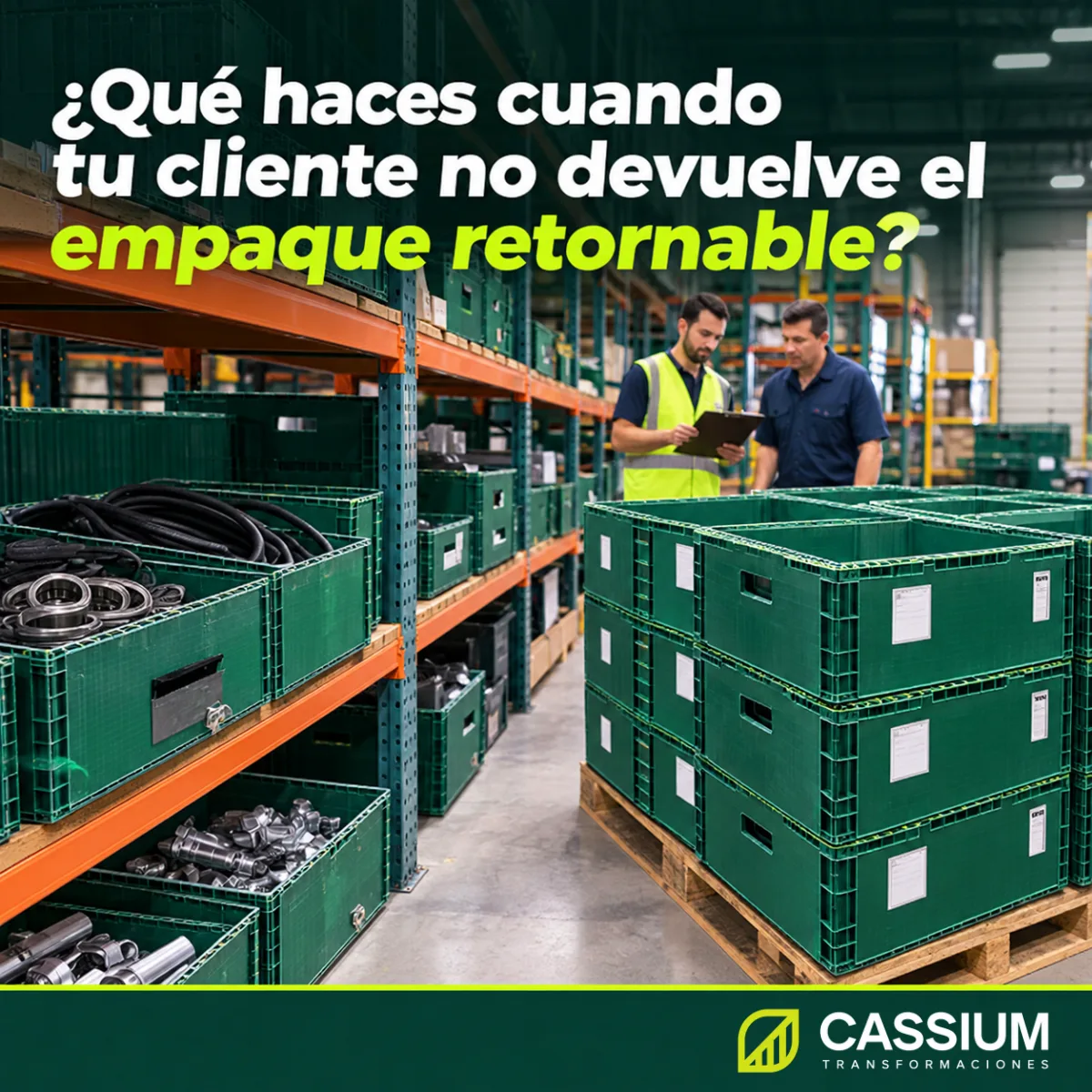
When your customer does not return your packaging, first reconcile a balance you can prove, recover what still exists, charge or replace according to a written agreement and fix the cause so the gap does not come back.
Why your boxes stay at your customer's plant
Boxes that do not come back almost always have an operational explanation: once empty, they no longer have any value for your customer's operation and nobody at its plant is accountable for them. Before you file a claim, it is worth understanding which of these causes explains your gap, because each one is solved differently.
Empties with no assigned place and no agreed pickup
If your customer's dock has no area for your empties and pickup depends on someone calling the carrier, the boxes scatter: some stay next to the line, others in an aisle and others behind someone else's material. When the truck arrives, the driver loads what he can see and the rest waits for the next trip, or disappears from the counts for months.
The warehouse that found free boxes
A clean, sturdy box of the right size is useful to anyone. If nothing in writing prohibits it, your customer's warehouse starts using it to store spare parts, move material between areas or separate rejected product. Those boxes are still inside its plant, but they have already left the loop, and in your counts they show up as lost.
Boxes that travel on to another plant or a third party
Sometimes your customer reships the product in your boxes to another of its plants, to a contract manufacturer or to its own customer. From that moment on, the box moves away from the agreed route and its return depends on someone who does not know your loop. This cause tends to be more expensive than the others, because those boxes rarely come back on their own.
Pickups without proof
When the carrier picks up empties without a slip showing the quantity signed by both parties, each company is left with its own version. Your customer says it delivered everything, your plant records fewer boxes received and nobody can prove where the difference went, as in the opening scenario.
Before you file a claim, build a balance you can prove
A claim based only on your internal records gets disputed; one based on documents your customer also signed gets resolved. The balance you will present comes from two sources: the boxes that left with each shipment, according to your delivery notes or packing lists, and the boxes that came back, according to the pickup slips and your receiving records, including the ones that arrived damaged and were written off. Outbound boxes minus documented returns give the balance that should be in your customer's possession.
The joint count: who counts, where and with what document
The paper balance is checked against a physical count at your customer's plant, made by one person from each company during the same visit. It is worth covering every area where there may be boxes: dock, warehouse, lines, reject area and yard. The result is written down in a brief report with the date, the areas checked, the boxes found in each one and the signatures of both representatives. That report is the basis for any later agreement.
How to classify the difference
The difference between the balance and the count is split into groups, because each group has a different way out:
- Boxes found in the customer's internal use: they are emptied and returned on the next pickup.
- Boxes sent to another plant or a third party: your customer requests them back within an agreed time frame.
- Boxes damaged at the customer's plant: they come back for inspection, even if they are no longer usable, and are recorded as written off.
- Boxes not located: once the search period ends, they are handled according to the replacement agreement.
If differences also turn up in your own records, for example pickups that reached your plant and nobody entered, it is worth acknowledging them in the same meeting. A reconciliation that corrects both sides builds more trust than one that only points at the customer.
Recover first: the cheapest box is the one that already exists
Before talking about money, schedule a special pickup with the list of boxes located in the count and ask your customer to take your boxes out of its internal use. For the ones that traveled to another plant or a third party, the shortest path goes through your customer: it has the relationship with that destination and can include your boxes in its own returns.
Damaged boxes should come back as well. They help you understand what damaged them, they document the write-off with your customer and their polypropylene can be ground and recycled to make new sheet. A damaged box that stays at the customer's plant ends up in its trash and, in your records, as a lost box.
The commercial agreement that decides who pays for the box that does not come back
Without a written agreement, every lost box is negotiated case by case and almost always ends up as a cost to your plant. There are three common arrangements that make it clear who is responsible for the packaging while it is in the customer's hands, and they can be combined. Before signing them, have your legal department review them and build them into the supply contract or an annex.
Free loan agreement: the fleet stays yours and the customer is responsible for it
Under a free loan agreement, known in Mexico as comodato, you lend the boxes to your customer to use at no cost, with the obligation to return them. The agreement sets the number of boxes it may hold, the maximum dwell time, exclusive use for your product and liability for loss or damage outside normal use. It works well with customers whose volume is stable, because the authorized balance is easy to monitor.
Deposit per box: the money comes back with the packaging
With a deposit, each box that ships with product generates a charge on the invoice, and each box that comes back generates a credit note for the same amount. The customer has a direct incentive to return the boxes and the loss is covered from the first shipment. In exchange, it requires more administrative work and your customer's acceptance of the charge, so it suits loops with many destinations or customers with no track record better.
Reconciled inventory with a replacement charge
Under this arrangement, both companies reconcile the balance as often as they agree, with a physical count and a signed report, and missing boxes above an agreed tolerance are charged at replacement value. The tolerance accounts for wear and normal counting errors. The replacement value includes the box, its interiors and its identification, with an update date. It usually works best when the relationship is long-standing and neither party wants to add charges to every invoice.
How to close the gap without breaking the relationship with your customer
The conversation goes better when you arrive with the count report, the documented balance and a concrete proposal. A sequence that usually works includes a short deadline to recover the boxes located, a longer one for those with third parties and, once both expire, replacement of the boxes not located at the agreed value or at one set in that meeting. If the contract said nothing about packaging, this is the opportunity to sign the agreement going forward, even if the earlier gap is settled through a one-time negotiation.
Meanwhile, your line needs boxes. Replacing them on time avoids emergency cardboard and gives the negotiation room, because the shortage of boxes stops putting pressure on your plant while you agree on who pays for them.
The rules that prevent the next gap
Almost all of the causes described above can be prevented with simple rules, written down and known on both docks. Ongoing fleet control deserves its own article; these are the points that directly affect the relationship with your customer:
- A pickup slip with the number of boxes, signed by whoever hands them over and whoever receives them, on every trip.
- An assigned area for your empties at the customer's plant and a fixed pickup frequency.
- Exclusive use of the boxes for your product and your route, in writing and communicated to the customer's warehouse.
- An authorized balance per customer and a maximum dwell time, with an alert when they are exceeded.
- One person in each company responsible for reconciling and resolving differences.
- Visible identification on every box, with your logo, a return notice and a sequential number; in another article we explain how to design it.
At Cassium Transformaciones we extrude our own sheet and make boxes, containers, dunnage dividers and trays at the same plant in Monterrey, under an ISO 9001:2015 certified quality management system. We print your identification during manufacturing so it withstands the cycles of the box, and we produce replacements with the same drawing and the same dimensional control as the original fleet, with no import lead times.
If the balance of boxes in your customer's possession has already grown beyond what your line can absorb, the first step is a joint count and a written agreement. At Cassium Transformaciones we manufacture replacements for your fleet in Monterrey with the same drawing as the original, and we design with you the identification that makes every reconciliation possible. Tell us how your returnable packaging moves at https://transformaciones.cassium.com.mx/en