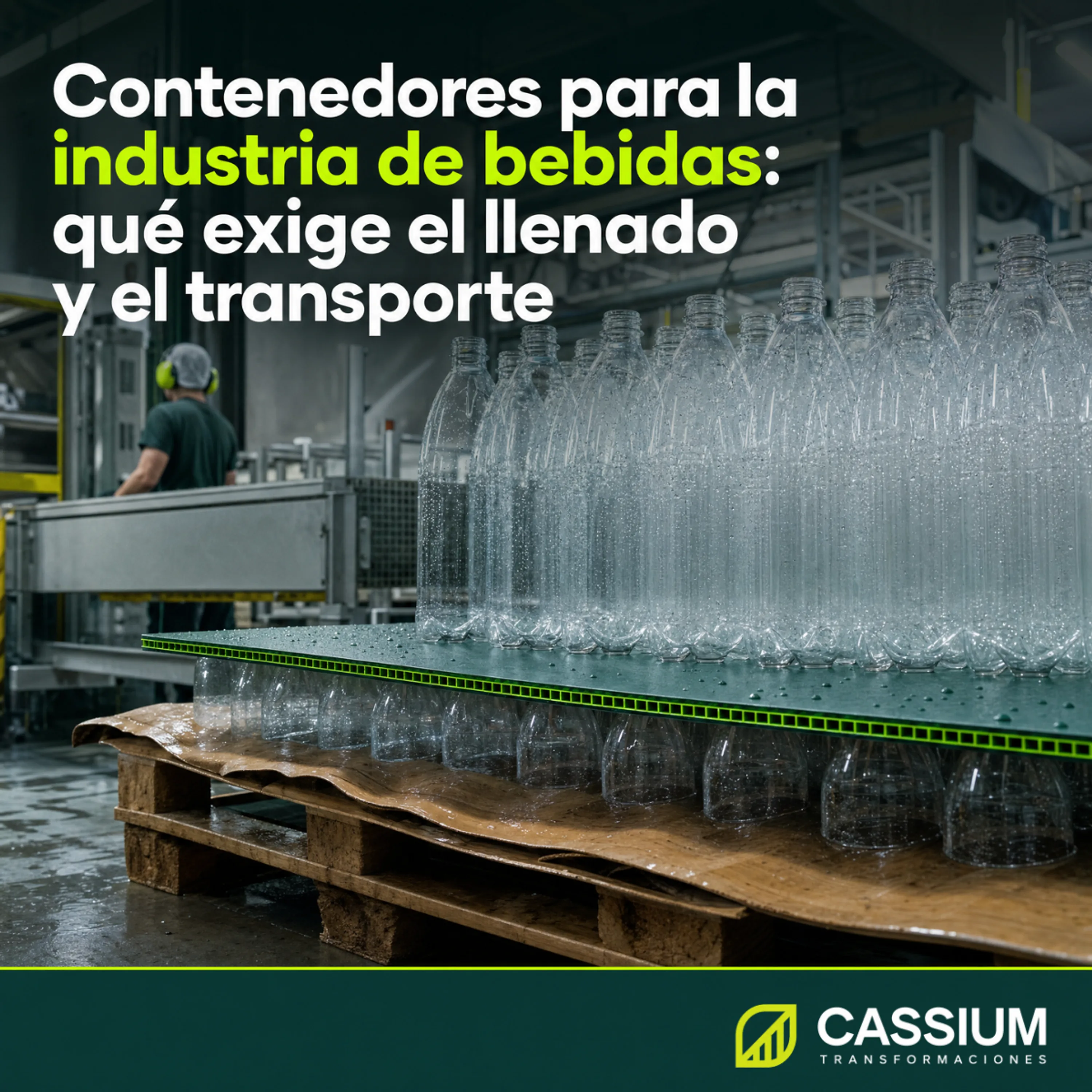
A beverage container must keep its stiffness in humidity and cold, hold the geometry the automatic line requires and support the weight of the full stack. That is specified in gauge, design and washing.
What a filling line does to packaging in a single shift
A beverage line is among the harshest environments for packaging: water on the floor, cold product sweating as it leaves the filler, syrup spills, frequent washing and automatic equipment that tolerates no out-of-spec piece. Packaging takes part at both ends of the line. At the infeed, the empty glass or PET bottles and cans arrive in layers on the pallet, with tier sheets between them. At the outfeed, finished product is placed in trays or in boxes with dividers and stacked for distribution. At both ends, packaging that changes shape with humidity stops the line or damages the product.
Condensation: the water that appears without anyone spilling it
When a beverage is cold-filled and moves into a warmer environment, the surface of the bottle or can is covered in condensation during packing and the first hours in the warehouse. The same thing happens when product leaves the cold room for the dock. Cardboard absorbs that water, progressively loses stiffness and deforms under load without anyone noticing until the stack leans. Corrugated polypropylene does not absorb moisture, so it keeps its stiffness with a wet bottle, in the cold room and after every wash.
Flatness and dimensions for automatic equipment
Depalletizers, palletizers and conveyors work with tolerances the operator cannot see. A warped tier sheet keeps the head from picking up the full layer; a deformed tray jams in the guide; a box with splayed walls will not enter the case packer. Each event is a stoppage, and every stoppage on a filling line is paid for in lost production for the shift. Polypropylene sheet keeps its flatness in humidity, and the orientation of its flutes defines the direction in which it is stiffest; that orientation is specified on the drawing according to how the equipment picks up the piece. Cutting tolerance also counts: an out-of-spec piece works on a hand-built pallet and fails on an automatic line.
Why the stack holds in the warehouse and collapses in the trailer
A pallet of beverages is a heavy, tall load, and almost all of its weight rests on the bottom layer. In the warehouse that load is static. In the trailer it becomes dynamic: every pothole, every braking and every curve adds stresses the packaging must absorb for hours. A stack that looked solid on the dock can arrive leaning at the distribution center, with the bottom layer crushed and product spilled over the rest.
Compression and load distribution between layers
The tier sheet and the tray perform a structural function that is often underestimated: they distribute the weight of each layer over the one below and keep the stack together as a block. If the material loses stiffness, the load concentrates at the points where the bottles and cans sit and the layer gives way. For beverages we normally work with gauges from 4 to 6 mm, and the exact gauge is defined by the weight per layer, the number of layers, the type of bottle or can and the route. A tray with tabs or raised edges also adds lateral containment that keeps the layer from shifting under braking.
Dividers that keep bottles and cans from colliding
Inside the box or tray, bottles and cans knock against each other with every vibration. In glass, the impact means breakage; in cans, dents the customer rejects; in PET, scuffed labels that hurt presentation on the shelf. Corrugated polypropylene dividers hold each unit in its own cell and absorb the rubbing, and because they do not soften with condensation they maintain that separation throughout the trip. The cell is sized to the actual bottle or can, with enough clearance for fast case packing and no room for the unit to knock around.
Temperature: from the cold room to the dock
The same container can go in a single day from the cold room to a hot dock and from there into a trailer. Corrugated polypropylene withstands the cold room and condensation, and keeps its stiffness through those changes. Even so, it pays to state in the specification the minimum and maximum temperatures the container will see, because the right formulation and gauge depend on them, especially when the product is stored below freezing or the packaging takes impacts in the cold.
The return trip decides whether the container turns out expensive or cheap
In beverage distribution, the returnable container circulates between the plant, the distribution centers and in some cases the customers, and its real cost is measured by how many cycles it completes before it has to be replaced. A corrugated polypropylene piece delivers up to 40 documented uses under normal handling conditions; whether it reaches that number depends on how it is designed for washing, for identification and for return handling.
Sugar residue, washing and drying
A soda or juice spill leaves sugar on the container's surface, and sugar attracts insects and encourages mold if the container is stored wet. Washing becomes part of every cycle. Polypropylene absorbs neither the liquid nor the sugar, and it withstands industrial detergent and pressure washing cycle after cycle. The design completes the task: edges that do not retain water, ultrasonically welded joints instead of adhesive, which degrades with washing, and a geometry that lets the container drain and dry before it returns to the line.
Identification that survives washing and the route
When the container leaves your plant for the distribution centers, it shares the dock with packaging from other suppliers in the same category. Sheet color and printing with your brand and the return legend make it recognizable from a distance and easy to recover on the next trip. We apply printing that withstands repeated washing, so the identification lasts as long as the container. If the return trip is long or space in the return truck is a problem, a collapsible design is another variable to consider from the start.
What to put in the specification before requesting a quote
A beverage container is quoted well when the manufacturer knows the line, the load and the route. These data points change the design and are worth gathering before the first meeting:
- The bottle or can: material, dimensions, filled weight and number of units per layer.
- The stack: number of layers per pallet, total height and whether the pallet is stacked on top of another one in the warehouse.
- The automatic equipment that handles the packaging: depalletizer, palletizer or case packer, with their tolerances.
- Temperature and humidity conditions: cold filling, cold room, dock and route.
- The return cycle: who receives, who returns, how it is washed and how many cycles are expected.
- Identification: color, logo, return legend and code, if your operation tracks each piece.
The prototype is validated on your real line
A tier sheet or a tray can look perfect on the engineer's table and jam on the palletizer's first cycle. That is why we deliver a prototype for your team to test on the real line, with the filled bottle or can, the shift's condensation and the automatic equipment running at its normal speed. Adjustments to dimensions, gauge or flute orientation are made before producing the fleet, when they cost little.
At Cassium Transformaciones we manufacture trays, dividers, tier sheets and returnable boxes for the beverage industry from sheet we extrude at our Monterrey plant, with cutting, folding, ultrasonic welding and printing in the same place and under an ISO 9001 certified quality management system. We design around your bottle or can, your line and your route.
If your filling line stops because of warped tier sheets or your pallets arrive leaning at the distribution center, packaging is a cause that can be corrected from the design. At Cassium Transformaciones we specify with you the container for your bottle or can, your line and your route, and we deliver a prototype before manufacturing the fleet. Tell us about your operation at https://transformaciones.cassium.com.mx/en