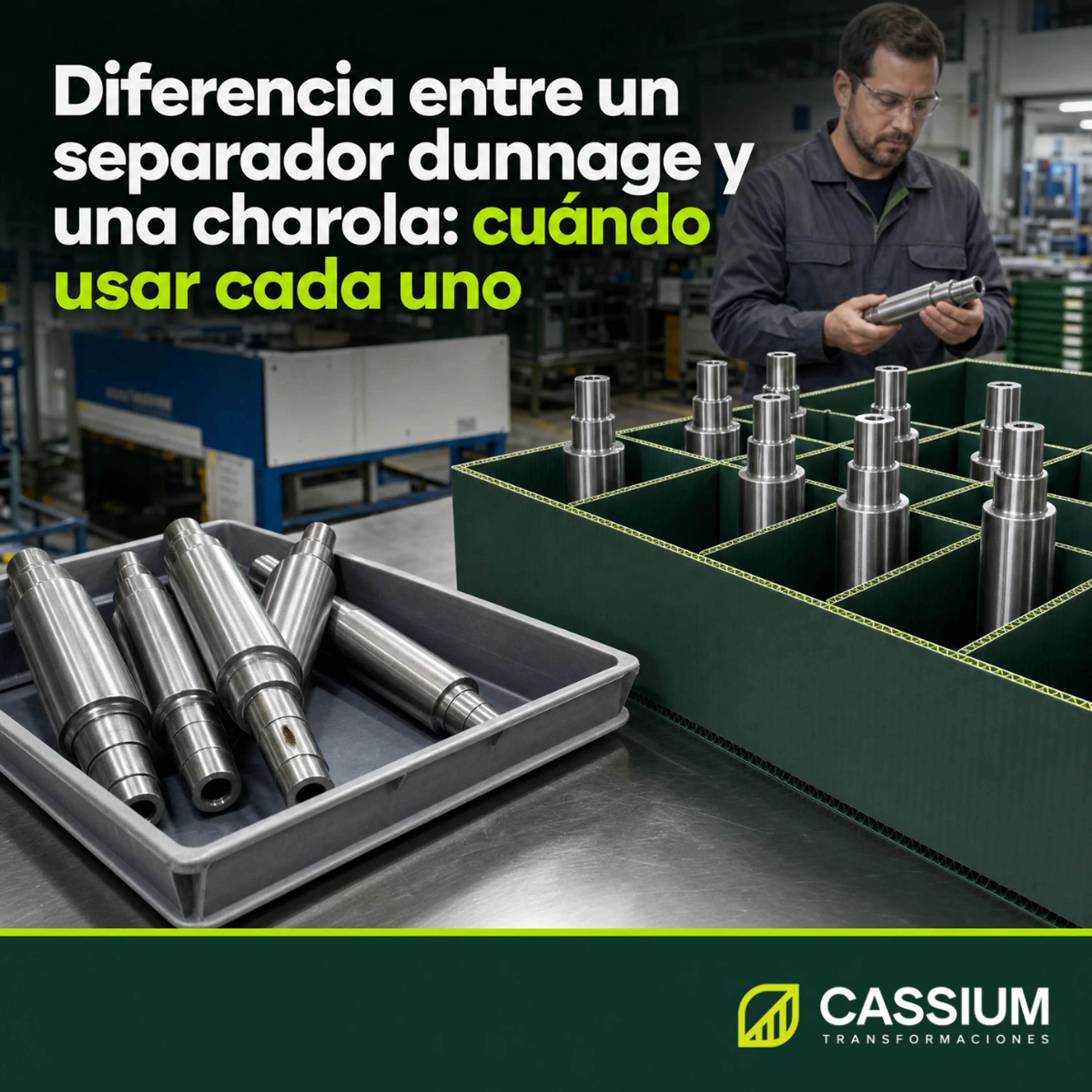
A dunnage separator holds tall parts upright, with side support; a tray holds flat parts lying down, with support across their whole base. Geometry, the sensitive zone and how the part is picked determine which one fits.
Why the same part arrives intact in one package and damaged in the other
We have explained in other articles what a dunnage separator is and how it prevents scratches on painted parts, and when a standard tray or a custom one makes sense. The question here comes earlier: faced with a new part, which of the two formats holds it better. The answer depends on how the part rests and where it takes the forces of transport.
A dunnage separator is a set of vertical sheet partitions that form cells inside a box or container; each cell holds one part upright, supported along its sides. A tray is a horizontal base with cavities or pockets formed in the sheet, where the part rests lying down; trays are stacked in tiers inside the container or in a stack of their own. Both are made of corrugated polypropylene, both are custom designed and both can coexist in the same package. What sets them apart is the direction in which they support the part.
Height-to-base ratio: the variable that decides whether the part stays put on its own
A tall part with a small base, such as a shaft, a vertical bracket or a cylindrical housing, has its center of gravity far from its point of support. Lying in a tray, it tends to roll or rotate inside the cavity every time the truck brakes; standing in a cell, the walls contain it along its full height and movement is limited to the design clearance. A wide, flat part, such as a panel, a plate or a cover, behaves the other way around: on edge in a cell it leans against its neighbors and flexes, while lying in a tray it rests on its entire face and spreads its weight.
Where the load concentrates: on the cell wall or on the tray base
In a separator, the side load from transport is taken by the cell walls, and the weight of the part is taken by the bottom of the container. In a tiered tray system, each layer rests on the structure of the tray below or on posts and walls of the container, so the parts on the lower level stay free of the weight of the level above. That difference defines how high you can stack, how heavy each part can be and what sheet gauge each case requires.
When a dunnage separator is the right way to protect the part
The separator wins when the part is taller than it is wide, when its side faces are sensitive and must stay apart from their neighbors, and when the line picks the part from the top down, one at a time, from the same box.
Full-height or partial-height cells depending on the sensitive zone
Partition height is designed around the part. A full-height cell protects the entire side face and makes sense when the visible surface is on the sides. A partial-height cell supports the part at its lower section and leaves the upper section free so the operator can grab it easily, and it makes sense when the grip zone is less critical than the rest of the part. The width of each cell is fitted to the real part with a controlled clearance: enough for the part to go in and come out without force, and small enough that it does not hit the walls in transit.
Density per container and top-down picking
A separator lets you fit many parts upright in a single box, in a fixed order that makes counting and picking easier. For tall parts, that usually means more parts per container than would fit lying down in trays, with fewer levels to handle on the line. If the container is collapsible, it pays to define at the design stage whether the partitions are removed or fold down with it on the return trip.
When a tray protects better than any cell
The tray wins with flat or thin parts that deform if they rest on edge, with small, numerous parts that would get lost in a large cell, and with processes that need each part in a fixed, repeatable position. It is also the natural choice when the part has a sturdy underside that can serve as support and a sensitive top face that must stay free.
Stacked tiers: each layer rests on the tray's structure
Tiered trays let you fill the height of the container without any part touching another. Each tray rests on the one below or on the container's structure, and the part stays in its cavity without taking the weight of the upper layers. For panels, plates, covers or flat parts with a painted surface, that separation by tiers prevents the face-to-face rubbing that happens when they are piled together inside a cell.
Repeatable position for robots, inspection or visual counting
A cavity formed in the tray fixes the position and orientation of each part. That lets a robot pick it at the same point every time, lets the operator see at a glance whether a part is missing and lets quality inspect the whole level without removing anything. On automated lines, that repeatability is often the deciding argument, even when the part could also travel in a separator.
The selection mistakes that end in scrap or rework
The cases we see most often share a common cause: the format is chosen based on the container that already exists or on upfront cost, and the part is made to fit it.
Tall parts laid down in trays to gain density
Laying a tall part down in a tray seems to make better use of space, but the cavity would have to be very deep to contain it, and a shallow cavity lets it roll. The typical result is dents at the ends and marks on the side surface, exactly in the zones a separator would have protected.
Flat parts on edge in cells to reuse a box
Putting flat parts on edge in an existing separator avoids designing a new tray, and when the cells are wider than the part, several end up leaning against each other. The edges bend, the faces rub, and the part at the back is hard to remove without dragging it against the others.
Combined solutions: a tray with dividers or a separator with a formed base
Some parts fall halfway between the two formats: a medium-height part with an irregular base, or a kit of several different parts for the same station. In those cases, the design combines both approaches: a tray with low dividers that separate each part, or a separator whose base has cavities that fix the part's position inside the cell. The decision is made with the real part in hand.
Five questions to answer before requesting a quote
These are the questions we ask at the start of a project, and your packaging engineering team should answer them before requesting a quote:
- Is the part taller than it is wide or wider than it is tall, and where is its center of gravity when it rests?
- Which faces are sensitive to contact and which can serve as support?
- How is it picked on the line: by hand or by robot, from above or from the side, one at a time or by level?
- How many parts should each container hold, and how much does each one weigh?
- How does the empty packaging return: assembled, collapsed or disassembled, and does it go through washing?
With those answers, the choice between separator and tray is usually clear, and the design moves straight to a prototype. At Cassium Transformaciones we manufacture both formats with sheet from our own extrusion at our ISO 9001:2015 certified plant in Monterrey, with cutting, folding, ultrasonic welding and printing, and in an antistatic version when the part includes electronics. We deliver a prototype with your real part so your team can test it on its line before manufacturing the fleet.
If your tall parts arrive dented or your flat parts arrive bent, review the packaging format before blaming transport. At Cassium Transformaciones we evaluate your part, your line and your route to recommend a separator, a tray or a combination of both, and we deliver a prototype before manufacturing the fleet. Tell us which part you want to protect at https://transformaciones.cassium.com.mx/en