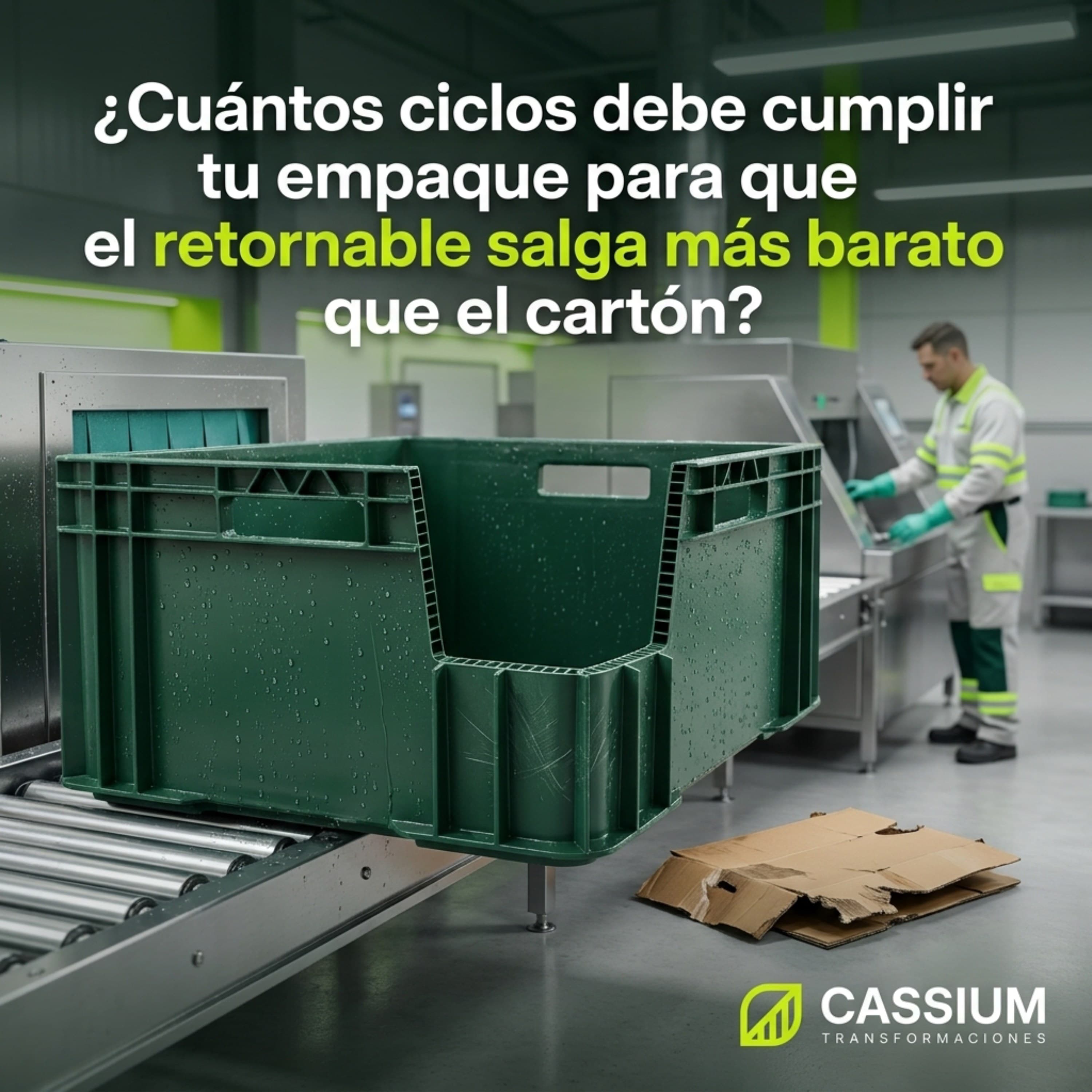
The break-even point is calculated using the real cycles the box survives, not a catalog figure. Cassium Transformaciones manufactures returnables rated for up to 40 uses, the number that determines when returnable packaging becomes cheaper than cardboard.
The Mistake That Inflates the Break-Even Point: Counting Cycles the Box Won't Actually Complete
Many packaging engineering teams calculate their return on investment using the service life listed on the supplier's spec sheet, without adjusting it to how the box is actually handled on their line. That theoretical number rarely survives the first six months of operation: how much a returnable box wears down depends both on the material it's made from and on the handling it receives at every link of the closed loop.
The result of that mistake shows up months later, when the quality team starts pulling boxes before the projected cycle and the savings that justified the project's approval shrink with every box retired. By then, the comparison against cardboard no longer favors returnable, and leadership is back to asking why the original number didn't hold up.
Declared Service Life vs. Real Service Life: What Stops the Count Before Cycle 40
The spec sheet describes the material's strength under controlled lab conditions. Daily operation adds variables that figure doesn't account for: compression from stacking during transport, moisture in the wash area if the packaging circulates through food or beverage plants, and friction from manual handling on an automotive assembly line. Each of these variables subtracts cycles from the initial projection. That's why the declared usage count, up to 40 per box based on Cassium Transformaciones' manufacturing capability, starts from a structural design built to absorb that wear, not a generic durability promise.
When the quality team pulls a box early, the real cause is almost always a handling factor nobody documented when calculating the return, not an intrinsic material failure. Documenting those variables before setting the cycle count keeps the break-even point from being calculated on an assumption the plant can't actually sustain.
In logistics and general manufacturing, the factor that cuts the most cycles is repeated manual handling in loading areas with no stacking protocol. In batteries and electronics, exposure to static friction during transport shortens the packaging's service life if the box doesn't have the right ESD variant. In pharma, periodic sanitization protocols demand a material that tolerates cleaning cycles without losing structural strength. Every sector wears the box down differently, and a reliable cycle count is confirmed with a design specific to the application.
Why Cardboard Looks Cheaper at First and Stops Being Cheaper at the Right Cycle
Cardboard wins the first comparison because its unit cost is low and it requires no upfront investment. That advantage only holds if you ignore that every cardboard box is bought, used once, and thrown away. Returnable packaging flips that logic: the cost is concentrated upfront and spreads out over each subsequent use cycle, until the cost per use drops below cardboard's unit cost.
That initial comparison also ignores the costs cardboard shifts onto other parts of the operation: storage space for constant replenishment inventory, the packaging waste that has to be segregated and disposed of, and the risk of product damage when cardboard gets wet or crushed during a long haul. None of these costs show up in the unit price compared in the first quote, but all of them hit the plant's real budget.
Cost Per Use: The Metric That Changes the Conversation With Finance
The comparison that decides whether the project gets approved happens between the cost per use of each option, not between the price of a single returnable box versus a single cardboard box. To calculate cost per use, divide the returnable box's price by the number of cycles it actually completes on the plant floor. With capacity for up to 40 uses, the cost per use of a Cassium Transformaciones returnable drops with every additional cycle, while cardboard repeats the same unit cost on every purchase, without exception.
The crossover point between both cost curves, the cycle at which returnable has already cost less per use than accumulated cardboard, is the number leadership asks for before approving the investment. That crossover depends on your operation's real volume, how often the closed loop rotates, and how many cycles your line can actually sustain before pulling the box, not on a generic supplier chart.
Packaging engineering doesn't run that calculation alone. Quality confirms how many cycles the box tolerates before the packaging fails an internal audit, and logistics confirms the closed loop's real rotation frequency, meaning how many times the box completes the round trip between your plant and the return point in a given period. When all three roles align their information before presenting the number to finance, the break-even point approved in the first meeting is the one that holds up in operation, without later adjustments that erode the project's credibility with leadership.
The Design That Determines Whether Your Box Reaches 40 Uses or Gets Pulled at Cycle 10
The declared cycle count corresponds to a specific structural design, not a generic catalog average: corrugated sheet gauge, reinforcement at the highest-stress corners, and joints built to withstand repeated handling without losing squareness. Cassium Transformaciones manufactures every box, tray, divider, and dunnage separator from its own corrugated sheet, which allows gauge and reinforcement to be adjusted to the weight and fragility of whatever your operation transports.
Ultrasonic-Sealed Joints: Where the Box Usually Fails Early
Most returnable boxes fail at the joint first, before the body material does. Cassium Transformaciones seals dividers, trays, and dunnage separators with ultrasonic welding, a process that fuses the material at the joint line with no adhesives or metal staples. That matters in operations where a loose staple is a physical contamination risk, as in food, beverage, and pharma, or an electrostatic discharge risk when handling batteries and electronic components. An ultrasonically welded joint doesn't come apart under repeated compression cycles, which is exactly where a glued or stapled joint starts to give out before cycle 40.
Before locking in the cycle count in your capex proposal, it's worth confirming with your supplier which joining process they use and which variant of the box fits your operation: UV finish if the packaging circulates outdoors or in humid areas, ESD variant if it transports components sensitive to electrostatic discharge, or corporate color if the returnable circulates between several plants and needs immediate visual identification. Cassium Transformaciones operates under ISO 9001:2015 from its plant in Monterrey, which means every batch of returnables ships with the same dimensional control criteria, with no variation between the first box in the order and the last. That level of specification is what separates a box that reaches cycle 40 from one that gets pulled before it recovers the investment.