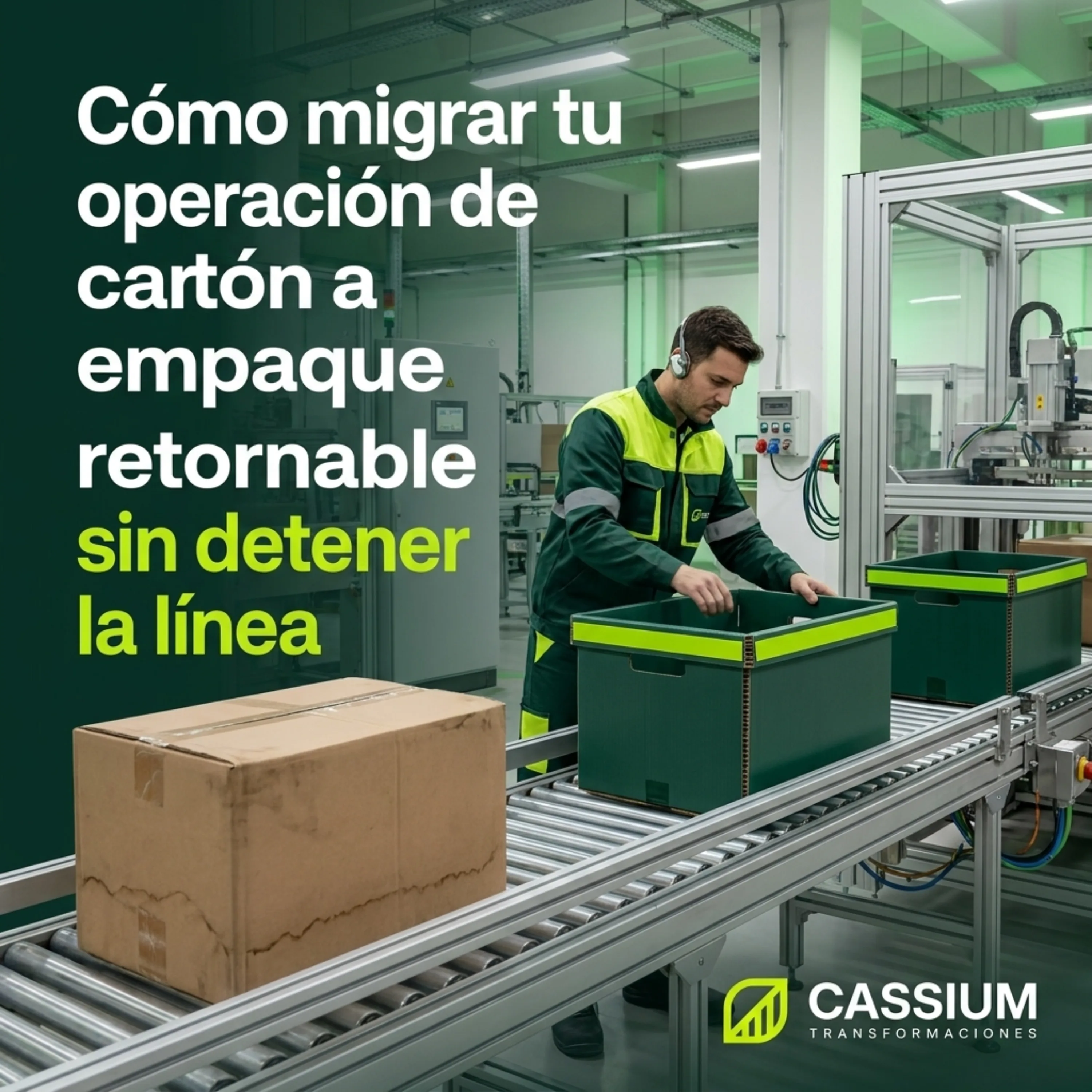
The migration happens in stages: one pilot route, a temporary overlap of both packaging systems, and a container fleet sized on the real return cycle. That way your line never runs out of packaging during the change.
Switching Everything Over in a Single Weekend Is the Shortest Path to a Line Stoppage
The temptation to migrate everything at once is understandable. The business case is already approved, the annual savings look clear on the spreadsheet, and management wants to see the benefit within the quarter. The problem is that returnable packaging introduces three variables cardboard never had: a container fleet you have to buy all at once, a return cycle you have to manage, and a learning curve for your people that plays out on the floor, with production running.
When the launch is all at once, those three variables debut on the same day. Any minor deviation in one of them turns into a packaging shortage at the picking station, and a packaging shortage stops the line just as effectively as a machine failure. A staged transition keeps cardboard as a safety net while each variable stabilizes on its own.
The Container Fleet Is Sized on the Full Cycle, Not on a Shift's Consumption
This is the most common miscalculation and the most expensive. Daily packaging consumption tells you how many containers get filled, and nothing about how many you need. The right number comes out of the full cycle: containers filled at your plant, containers in transit outbound, containers on the customer's floor waiting to be consumed, empty containers in transit back, containers in washing or inspection, and a contingency buffer for transport delays.
A route with two days out and two days back, plus two days sitting at the customer, runs a cycle close to a week. That cycle multiplies your daily consumption and defines the real investment. If the fleet is bought against a shift's consumption, the line runs out of packaging on the third day and purchasing ends up covering the gap with cardboard, which is exactly the expense the project set out to eliminate.
The Geometry Nobody Measured: Racks, Pallets, and Access
A returnable container takes up a different volume than a cardboard box, holds its shape when empty, and stacks differently. Before manufacturing the fleet, it's worth measuring three things on the floor: the clear opening of the racks at the picking station, the footprint on the pallet you ship with, and the storage space for the empty containers coming back. That third point catches many plants off guard, because empty cardboard collapses and returnable packaging doesn't.
Design can solve almost any constraint if it's known in time. We adjust the box height so it fits the existing rack, modify the footprint to optimize stacking on your standard pallet, and work with collapsible geometries when the return of empties is the bottleneck. What can't be solved is a constraint that shows up on the Monday of the launch, with the entire fleet already manufactured.
The Pilot Route Decides Whether the Project Moves Forward or Gets Cancelled
The first stage of a migration should be small, measurable, and reversible. One part number, one route, one customer. The purpose of that stage is to generate the data you'll use to size everything else. The savings come later, when the full volume enters the loop.
Criteria for Choosing the Part Number That Opens the Transition
The best candidate combines four conditions. High, stable volume, so the cycle repeats many times over a few weeks and the data is reliable. A part with a history of damage in cardboard, because the benefit becomes visible immediately. A short route with a single destination, so the return cycle is easy to track. And a part whose design is frozen, with no engineering changes scheduled during the pilot.
It's best to avoid low-turnover part numbers, routes with multiple destinations, and parts undergoing redesign as pilot candidates. Any of those conditions introduces noise into the measurements and leaves you without the information you need for the second stage.
The Variables to Measure During the Pilot
Over the first few weeks there are five data points worth more than any spreadsheet projection. The real return cycle in days, measured container by container. The percentage of containers that don't come back on each trip. The assembly and knockdown time per operator, timed on the floor. The incidence of part damage compared against the cardboard baseline. And the actual space the empties take up in your warehouse.
With those five numbers the final fleet stops being an estimate. The design adjustments worth making before manufacturing the full volume also surface, and that is precisely the window a full migration over one weekend eliminates entirely.
The Overlap Between Both Packaging Systems Is the Stage Most Often Underestimated
For several weeks your plant will run cardboard and returnable packaging at the same time. That stage isn't a passive transition period; it requires explicit rules, because it's where shipping errors and container losses get generated.
Identification and Control of In-Transit Inventory
Every returnable container needs permanent identification that survives washing and handling. Printing directly on the sheet withstands cleaning cycles an adhesive label can't take, and it lets you mark part number, customer, and container ID legibly at the dock. Without that identification, the fleet becomes invisible: nobody knows how many containers are at the customer, how many are on their way back, and how many simply disappeared.
In parallel, it's worth opening a specific inventory position for in-transit packaging, with a weekly count. The trickle of lost containers tends to be slow and silent over the first few months, until one day the fleet no longer covers the cycle and the plant goes back to ordering cardboard. A weekly count catches that trickle while it's still fixable.
Shipping Rules That Keep One Packaging System From Being Used as the Other
While both systems coexist, the most common operational risk is cross-shipping: parts from the pilot part number go out in cardboard because the returnable container wasn't available, or returnable containers get used for a destination that isn't in the loop and never come back. Both situations destroy the pilot data and throw off the fleet count.
The rule works best when it's written down and posted at the station: which part number travels in which packaging, to which destination, and with which paperwork. Your shipping supervisor needs to be able to settle the question without calling anyone, because the night shift doesn't always have someone to ask.
Your People Determine Whether the Migration Holds
Returnable packaging changes the routine of whoever uses it. A collapsible container gets set up and knocked down, a divider has a right orientation and a wrong one, and a damaged container gets reported instead of discarded. None of those behaviors is intuitive for a team used to assembling cardboard and throwing it away.
Training on Assembly, Stacking, and Damage Reporting
Effective training happens with the container in hand, at the actual workstation, and with the real part. Three points account for nearly all the problems of the first few months: the correct assembly and folding sequence, which avoids stress on the welded joints; the maximum stacking height with a full container, which guards against wall deformation; and the damage reporting procedure, which lets you pull a compromised unit out of the loop before it fails with product inside.
That last point is what sustains the fleet's service life. Our boxes are designed to reach up to forty uses, and that number depends as much on the material as on the handling they receive at both ends of the loop. It's worth extending the same training to the customer personnel who receive the containers, because half the cycle happens outside your plant.
The Redesign Window You Shouldn't Close
After the pilot, a short list of adjustments usually appears: a cell that needs two more millimeters of clearance, an inspection window the side panel was missing, a handle that makes rack handling easier, a divider better welded than inserted. That list is the most valuable asset of the entire first stage.
At Cassium Transformaciones we extrude our own sheet and manufacture the finished product at the same plant in Monterrey, with cutting, folding, ultrasonic bonding, and printing under one roof. That makes it possible to build those adjustments in before releasing the full volume, without depending on a third party's schedule or on someone else's tooling. A staged migration works when your supplier can move at the speed of your findings.