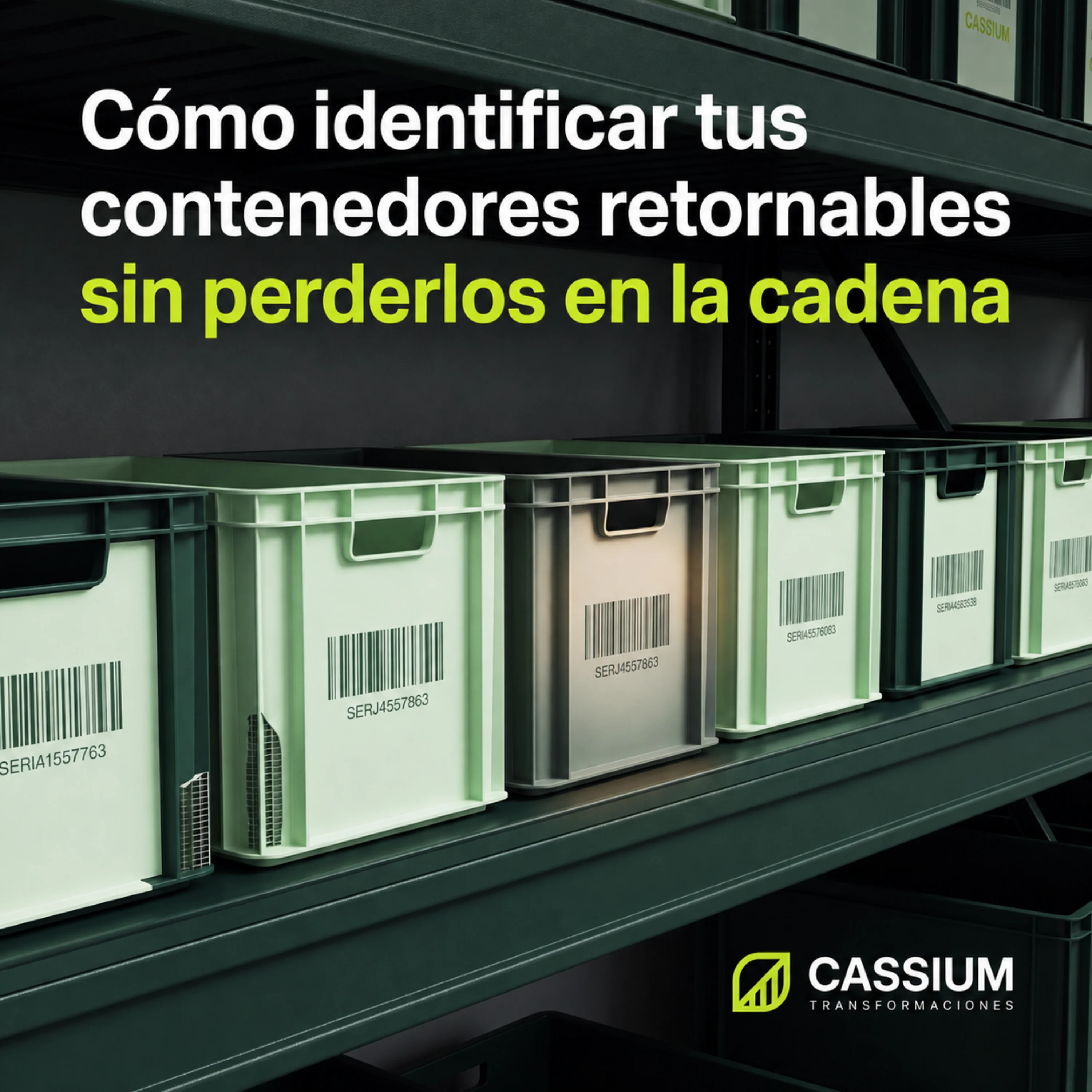
Lost returnable containers almost always start with a lack of visible identification. A printing, corporate color, and coding system designed for your closed loop lets you recognize and recover every container before it breaks the cycle.
The Invisible Cost of a Container That Doesn't Come Back
In closed-loop operations, every container that doesn't come back represents two costs that rarely land on the same spreadsheet: the cost of replacing it, and the cost of the disruption its absence causes in the next production or dispatch cycle. When your logistics team has no way to visually identify which customer, line, or process a container belongs to, that container becomes indistinguishable from the generic packaging circulating through the same yard, the same dock, or the same third-party warehouse.
This problem grows with volume. The more plants, customers, or routes your closed loop handles, the easier it is for a container without clear identification to end up mixed up, stacked with material it doesn't belong to, or pulled by mistake during a yard cleanup.
This loss isn't just a logistics issue. In automotive, pharma, batteries, or food and beverage, your packaging engineering team designs the container with the process in mind, your quality team validates that the identification doesn't interfere with hygiene requirements or material compatibility, and your logistics team reports how many units went in and out of the closed loop each period. When these three departments don't share the same identification criteria, the physical count and the system record start to diverge without anyone noticing exactly where traceability broke down.
Visual Traceability: The Mechanism That Keeps the Container From Getting Confused on the Floor
The mechanism that solves this confusion is simple: make the container identifiable at a glance, without the operator having to open an app or check a database to know who it belongs to. A corporate color applied consistently across your entire returnable container fleet works as the first layer of visual traceability, letting anyone on the dock instantly recognize that the container doesn't belong to another supplier.
The second layer is printing: the logo, the mandatory-return legend, and, when the process requires it, an ID code or sequential numbering visible on more than one face of the container. This cuts down human error at the exact point where containers get lost the most, manual handling on the dock and in the yard. At Cassium Transformaciones we combine direct printing on the sheet with cutting and folding processes that respect the position of the code or logo, so the identification doesn't end up on a fold where it bends, hides, or becomes illegible after the first handling.
When Corporate Color Stops Being Brand Identity and Becomes Asset Control
Corporate color is usually thought of as a branding decision, but in a closed loop it serves a different function: it's the variable that lets your logistics team count, sort, and recover containers without depending on someone remembering which customer each one belongs to. When color is applied only for aesthetics and not as part of the identification system, it loses most of its operational value.
At Cassium Transformaciones we apply corporate color as an integrated service within your container's printing process, starting at the corrugated sheet design stage, before cutting and folding. That means the color, the logo, and any ID code get defined at the manufacturing origin, so the identification survives the same number of cycles as the container.
This same principle applies beyond the returnable container: when your closed loop also includes dividers, custom dunnage separators, or point-of-sale displays, keeping the same corporate color and coding criteria across the entire packaging family makes it easy for your team to identify at a glance which pieces belong to your operation, no matter where in the chain they are.
High-Resistance Printing: How It Survives Use Cycles Without Losing Legibility
The technical mechanism behind identification that lasts is how well the printing resists repeated handling. A returnable container in a closed loop can complete up to forty use cycles between cleaning, transport, stacking, and forklift handling. If the printing isn't designed to withstand that wear, the color fades, the logo chips off, and by around cycle twenty the container no longer stands out clearly enough for you to recover it on a customer's dock.
That's why print resistance matters as much as the design itself: it guarantees the identification stays as legible at cycle forty as it was at cycle one, and lets your logistics team trust the color and the code without having to check every container up close.
The System That Turns Identification Into Guaranteed Recovery
Identifying a container is the first step, but the complete system needs a counting mechanism that connects that identification to your asset control. A code or sequential numbering printed on the container lets you register each unit, cross-check that record against the physical count on every return, and immediately spot when a unit is missing, instead of discovering it months later during a general inventory.
This system integrates with the asset control your logistics team already runs, giving the container the physical identification that process needs to function precisely at every point in the chain, from the moment it leaves your plant until it comes back.
This cross-check works best when it's reviewed on every return, not just at month-end close. A counting system that only gets audited monthly lets shortfalls build up for weeks before anyone notices, while a per-return cross-check catches it in the same cycle it happened, while it's still possible to trace exactly where in the chain the container got stuck.
Codes and Sequential Numbering: The Counting Mechanism on Every Return
The operating mechanism is straightforward: every container leaves production with a visible code or number that your team registers in the asset control system from its first use. On every return, that same code lets you confirm the container that came back is the one that went out, count received units against expected units, and immediately isolate any discrepancy before it builds up across several cycles.
This numbering also makes it easier to audit each container's real wear over its service life. If a particular code starts generating damage reports more often than the rest of your fleet, your quality team can spot the pattern and adjust the design or the handling before the problem repeats across the rest of the containers with the same identification. That same report also helps you decide when a specific container has reached the end of its service life and should be retired before its identification becomes illegible and loses its function within the closed loop.
At Cassium Transformaciones we design your returnable container's identification as part of the manufacturing process. We apply corporate color, high-resistance printing, and sequential coding onto your own corrugated sheet, with cutting, folding, and ultrasonic processes that guarantee the identification survives the same service life as the container, from our ISO 9001:2015-certified plant in Monterrey. Whether your priority is packaging engineering, quality, or logistics, a correctly identified container is a container your closed loop can track, count, and recover on every cycle. We work on this identification together with your packaging engineering team from the design stage, so the color, the code, and the print resistance match the way your closed loop actually operates.