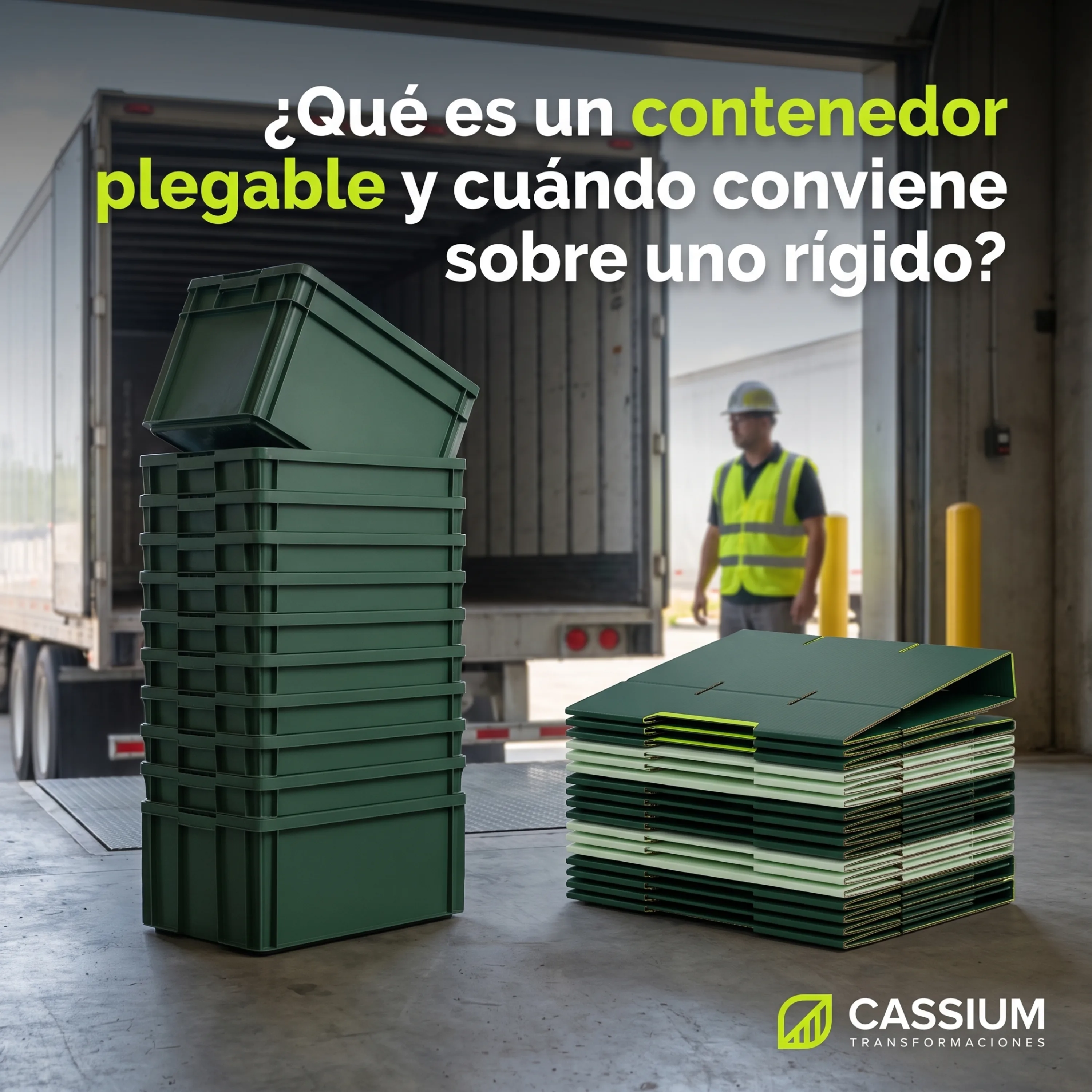
A collapsible container is a returnable package whose walls fold down onto the base when it travels empty, so it takes up a fraction of its volume on the return trip and in storage. It pays off when the return is long or frequent and empty space costs money; the rigid one wins when load, automation or washing demand a piece without joints.
The cost nobody sees: the return trip
When a company migrates from cardboard to returnable packaging, it calculates the savings on the outbound trip and usually forgets the return. Cardboard is discarded at destination; the returnable comes back. If the empty container takes up the same volume as a full one, every return truck carries air at the price of a full freight, and the plant yard accumulates empty containers competing for space with the operation. On long routes or with frequent returns, that cost can eat the savings that justified the change.
How much air travels in a return truck
An empty stackable rigid container takes up the same space as a full one, unless it is nestable. A collapsible container, with its walls folded onto the base, reduces its height to a fraction and allows several to be stacked in the space one used to occupy. The difference translates directly into return trips per month, into square meters of yard and into the number of containers needed to sustain the loop.
How a collapsible corrugated sheet container is built
In corrugated polypropylene sheet, a collapsible container is built from a base and four walls joined by scores that work as hinges. The material has the property of folding along the same line thousands of times without breaking, which makes it possible for the container to open and close on every cycle without hardware or additional moving parts.
Score, hinge and closure
The score is a compression line that marks where the wall folds without cutting the face of the sheet; its depth and its position relative to the flute decide whether the hinge lasts the life of the container or cracks after a few cycles. The walls are held in the assembled position by flaps, tabs or snap closures designed into the die itself, and the folding sequence is defined so the walls lie flat and the whole stacks stably.
What is lost by folding and how it is recovered
Every joint is a point where the wall is not continuous, and that takes stiffness away compared with a one-piece container. It is compensated with the gauge and grammage of the sheet, with reinforcements at the edges and the base, and with a closure design that works in compression when the container is loaded. A well-designed collapsible withstands the load and stacking of its application; a poorly designed one opens up in the truck.
When the collapsible wins
There are four situations where the collapsible returns more than its design costs.
Long or frequent return
When the customer's plant is hundreds of kilometers away, or when the loop turns several times a week, every return truck saved is money on the books. If the empty containers come back in a fraction of the space, the same truck brings more and freight per unit goes down.
Scarce yard or warehouse space
Empty containers wait between cycles: in your plant's yard, at the customer's dock, in the logistics operator's warehouse. When that space costs money, or when it simply does not exist, the collapsible turns a mountain of containers into a few stacks.
Loop with several destinations or with seasonality
If the same fleet of containers serves several customers, or if demand has peaks and valleys, the containers out of use are stored folded without taking up the operation's space. A rigid fleet sized for the peak occupies that space all year.
Light or bulky parts
When what is transported is bulky but not heavy, plastic auto parts, light assemblies, bagged finished product, the container does not need the extreme stiffness of a one-piece box and the collapsible does the job with margin.
When the rigid one is the better choice
The rigid container, one-piece or with fixed walls, wins in the situations where a joint is a risk or a nuisance.
With heavy or concentrated loads, the continuous wall carries more and does not depend on a closure. On automated lines, with conveyors, robots or automated storage systems, the container must always have the same geometry, and a poorly assembled collapsible stops the line. In loops with intensive industrial washing, the joints accumulate residue and fixed walls clean better. And in short loops, where the return is a few meters or the container lives inside the same plant, the volume savings do not justify the additional design.
A case: the route that changed the decision
An auto parts plant supplied two customers: one twenty minutes away, in the same industrial park, and another six hundred kilometers away. It used the same rigid container for both. When it separated the calculation by route, it found that on the short route the rigid container was the right choice: daily return, no intermediate storage, conveyors at the customer's dock. On the long route, by contrast, the return truck traveled every week full of empty containers, and the customer had nowhere to keep them between shipments. Designing a collapsible only for the long route cut return freight to a fraction and freed space in both yards. The decision was not rigid or collapsible for the whole plant; it was one for each route.
The question that decides: how much does empty space cost
The decision comes down to comparing the cost of empty space over the cycle, in return freight and in storage, against the additional design cost and the loss of stiffness of the collapsible. When empty space costs more than the joint, the collapsible wins. We explained in another article the material differences between corrugated and rigid injection-molded plastic; the choice between collapsible and fixed is made after that one, based on the real return cycle.
How a collapsible is designed for your part
The design starts from the part that goes inside, from the clearance of the racks and from the dock where it will be assembled and taken down. The base with its reinforcement, the gauge and grammage of the walls, the position of the scores relative to the sheet flute, the type of closure and the folded height are defined. A prototype is made, assembled and folded dozens of times, loaded with the real part and stacked the way it will travel. Only then is the fleet produced.
The prototype also defines the assembly and folding procedure the operator will follow at the dock: in what order the walls are raised, how the closure is secured and how it folds to lie flat. A collapsible that takes three minutes to assemble, or that allows being assembled wrong, ends up traveling open or badly closed. That procedure is documented with photos and delivered with the fleet, because the container will be assembled by different people at two different plants.
At Cassium Transformaciones we design and manufacture collapsible containers at our Monterrey plant, with sheet from our own extrusion, cutting, scoring and assembly in the same place. When the part changes, we adjust the design without remaking the entire fleet.
If your return truck travels full of empty containers, the cost of packaging has a component nobody put in the calculation. At Cassium Transformaciones we design the collapsible around your part and your real cycle, with a prototype before the fleet. Tell us about your return route at https://transformaciones.cassium.com.mx/en