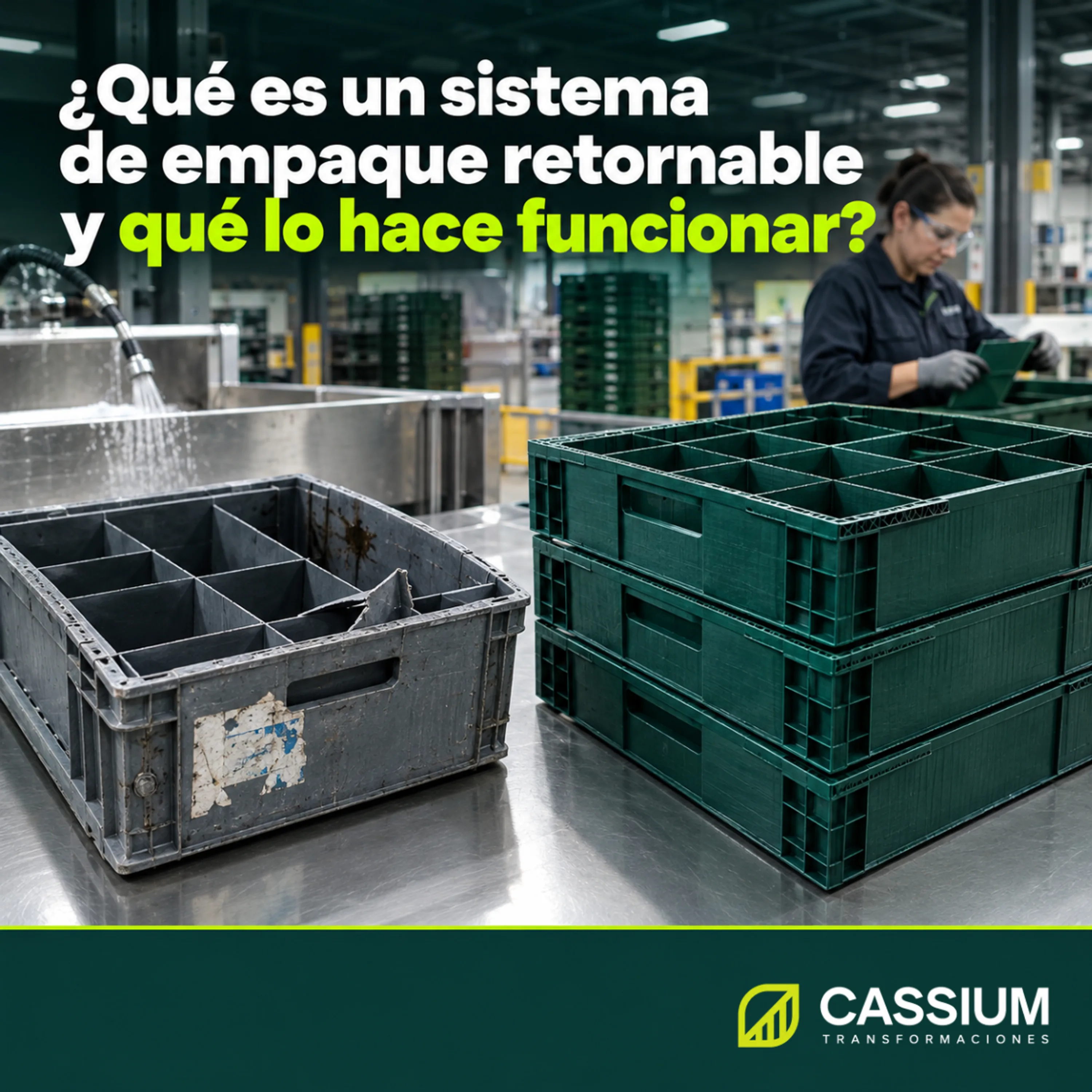
A returnable packaging system combines containers designed for many cycles with a defined route, cleaning and inspection on return, balance control at every point and written agreements with your customer.
Why a fleet of returnable boxes can end up in emergency cardboard
A returnable packaging system is a way of operating in which the same container leaves your plant full, delivers its contents, comes back empty and is filled again, cycle after cycle, throughout its service life. We have already explained in another article what a closed loop is and why it changes the packaging you need. Here we look at what makes that loop work day to day, because the box is only one of its parts.
Cardboard closes its own cycle: it is bought, used and discarded at the destination. Returnable packaging leaves a pending task on every trip: bringing it back in usable condition. When nobody is assigned that task, boxes get stuck along the way or come back dirty or damaged, and the savings that justified the project turn into emergency purchases.
The five components: packaging, fleet, route, rules and owners
Every returnable system that works has five defined elements. The packaging: container, interiors (dunnage separators, trays or dividers), lid and pallet when they apply. The fleet: the total number of containers in circulation, sized for the full cycle. The route: every point the box passes through and how long it stays at each one. The rules: how the box is filled, how it is delivered, how it comes back and when it is retired. And the owners: one person or one area for each point, accountable for the boxes while they are there. If any of the five is missing, the system depends on the goodwill of whoever finds the boxes.
The outbound and return route: where a box gets stuck
Mapping the full route is the first exercise worth doing before you switch to returnable packaging. It almost always reveals a point nobody had considered, where stalled boxes pile up.
Outbound: filling, shipping and receiving
The cycle starts at your plant, when the empty, released box reaches the filling station. The operator places the parts in their cells, the box is identified with the shipping label and stacked to the defined height and order. At the customer's dock, receiving confirms quantity and condition, and the box goes to their warehouse or straight to their line. This leg usually works well because it is the same one that already operated with cardboard: the product requires someone to receive it and record it.
Return: emptying, consolidating empties and the trip back
The return is where control is lost. Once empty, the box has no value for the customer and starts getting in the way next to their line. The system needs an assigned place for empties at the customer's plant, a rule on how they are left (empty, without labels from the previous shipment, collapsed if the design allows it and stacked on a pallet) and an agreed pickup frequency. If the return truck comes once a week, a box can wait up to seven days on the dock, and those days are also part of the cycle your fleet has to cover.
When return freight or space for empties weighs on cost, a collapsible container reduces the volume of that leg; we have compared in another article when it pays off over a rigid one.
Cleaning and inspection: the station that decides whether the box goes back in service
Between the return and the next filling there has to be a control point, even if it is just a table next to the dock. That is where any residue is emptied out, old labels are removed, the box is cleaned when the process calls for it and someone decides whether it goes back into service, gets repaired or leaves the fleet. Without that station, every damaged box that comes back travels again with product inside.
Cleaning: frequency and method based on what the box carries
Cleaning frequency depends on the industry and the product. In automotive and general logistics, removing dust and debris when the box needs it is often enough; in food, beverages and pharmaceuticals, the plant's procedure usually sets cleaning per cycle, per batch change or on a schedule, with a record. Corrugated polypropylene does not absorb water, washes with water and detergent and dries quickly, which allows cleaning to be built into the cycle without taking boxes out of circulation for days. Design also plays a role: closed edges, cells with room for a cloth and staple-free joints make thorough cleaning easier.
Return inspection: criteria to accept, repair or retire
Inspection works when the criteria are written down and illustrated with photos: which damage is acceptable, which is repaired and which retires the box. A broken divider, a deformed inner tray or illegible printing can be fixed when the design allows the damaged part to be replaced without scrapping the whole box; that is why it is worth defining from the design stage which components can be replaced and ordering spare parts together with the fleet. A fractured base, a wall that is no longer square or an open joint retires the box, because the next trip puts the product at risk.
Without balance control, the fleet drains away without anyone noticing
A returnable fleet is an inventory of assets spread across your plant, transportation and your customers' facilities. If you only count what is inside your plant, losses show up when the line has already run out of boxes.
Balance by point: how many boxes each party holds at any given time
Minimum control records three movements: the boxes that leave with each shipment, the ones that come back with each pickup and the ones retired at inspection. With those three figures, each customer has a balance of boxes in its possession that is reconciled with a physical count on its dock, as often as both parties agree. If the balance grows week after week while consumption holds steady, boxes are getting stuck along the way or someone is using them for something else. Identifying each box with color, printing and a sequential number makes that count possible, and in another article we explain how to design that identification.
The agreement with your customer that nobody signed and your plant ends up paying for
Returnable packaging crosses the boundary of your company, and half of its cycle takes place in facilities you do not control. That is why the system needs a written agreement with each customer, even if it is a short annex to the supply contract. These are the points worth defining before the first shipment:
- Fleet ownership: who buys the boxes, who records them as an asset and who pays for replacements.
- Exclusive use: the boxes are used only for the agreed product and route, and are kept out of the customer's internal storage and its shipments to third parties.
- Return conditions: empty, without previous labels, free of trash, collapsed if applicable and stacked on a pallet in the assigned place.
- Pickup lead time and frequency, and who pays the return freight.
- Liability for loss or damage outside normal use, with the replacement value per box and the counting criterion that supports it.
- A responsible contact at each plant to reconcile balances and resolve discrepancies.
Rules that are applied on the dock and reach every shift
An agreement known only to purchasing and sales leaves dock operations unchanged. The rules that affect daily work (where empties are left, how they are stacked, who a damaged box is reported to) must reach the customer's receiving supervisor and your shipping supervisor in writing and with photos. It also pays to train whoever receives and empties the boxes, because how they handle them determines how many cycles each one completes.
Packaging designed for the entire route
Container design can make each stage of the system easier or harder. A collapsible container reduces the volume of empties on the return trip; closed edges and ultrasonic welded joints make cleaning easier; color and printing that withstand washing support balance control; interiors with replaceable parts allow repair instead of retirement. That is why, when we design returnable packaging, we ask about the part and also about the route, the cleaning, the counting and the way your customer is going to return the boxes.
At Cassium Transformaciones we extrude our own corrugated polypropylene sheet and convert it at the same plant in Monterrey, under an ISO 9001:2015 certified quality management system, with cutting, folding, ultrasonic welding and printing. We make boxes, containers, dunnage separators and trays designed to reach up to 40 uses, and replacement parts come from the same drawing and the same process as the original fleet.
If your returnable boxes are already in circulation and each customer's balance is still an estimate, the next step lies in the system around them. At Cassium Transformaciones we design the packaging together with your actual route, your cleaning method and the way you control your fleet, with a prototype before production. Tell us how your packaging moves at https://transformaciones.cassium.com.mx/en