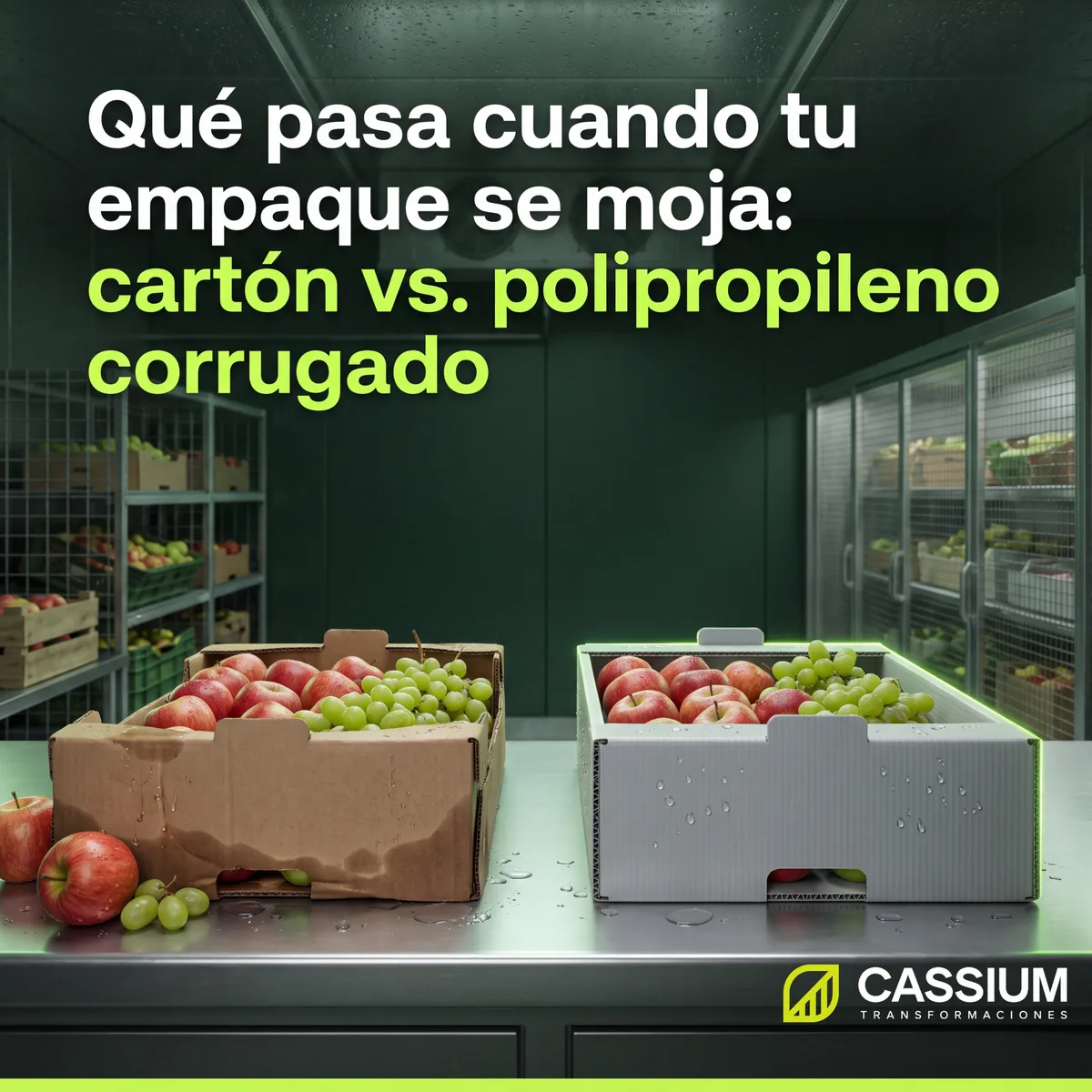
Your packaging doesn't fail by accident. It fails because the material it's made of wasn't designed for what you're asking of it. At Cassium Transformaciones we manufacture returnable boxes, trays and dividers in corrugated polypropylene in Monterrey, and this is the question plant managers ask us most before switching suppliers: what exactly happens to cardboard when it gets wet, and why doesn't corrugated plastic have that problem?
What happens inside cardboard when it gets wet
Corrugated cardboard is cellulose fiber glued with starch adhesive. Both materials react badly to water, and they do it at the same time.
The fiber swells and the adhesive dissolves
Cellulose absorbs water like a sponge: it swells, loses rigidity, and the cardboard layers start separating. The starch adhesive that held them together dissolves in that same moisture. The result is a box or tray that still looks intact from the outside, but has already lost the structural strength it had when it left the factory.
That's why the failure almost never happens the moment the packaging gets wet. It happens later, when someone loads or stacks it trusting a strength that's no longer there.
It sheds fiber onto the product
When cardboard softens, it doesn't just lose shape. It also starts shedding loose fiber, especially at cut edges and high-handling areas. On a food line that's a problem that goes beyond broken packaging: it's physical contamination of the product, and in most quality protocols that means discarding the entire batch, not just the packaging.
Cardboard doesn't recover between uses
Even if cardboard dries out after getting wet, it doesn't return to its original strength. The fiber stayed deformed. That's why a cardboard box that already went through moisture isn't fit for a second cycle even if it looks usable at a glance, and why in practice cardboard delivers between one and three uses before it needs replacing.
Why corrugated polypropylene doesn't have that problem
Polypropylene is a plastic, not a plant fiber. It has no pores that absorb water and no adhesive between layers that can dissolve.
Zero moisture absorption
A PP corrugated tray or box can spend an entire night under cold-room condensation and come out with the same strength it went in with. There's no material swelling or loss of rigidity because there's nothing to absorb the water. The gauge we use for food lines is 3 to 5 mm, enough to hold the weight without moisture entering the equation.
Withstands industrial washing without shedding
Unlike cardboard, corrugated PP doesn't just resist accidental water. It withstands pressure washing with industrial detergent, dries, and goes back on the line the same day. It doesn't shed fiber or particles in the process, so washing doesn't become a new source of contamination.
Delivers far more cycles than cardboard
A corrugated PP piece delivers up to 40 documented uses under normal handling conditions, compared to the one to three uses cardboard delivers before losing shape. That means after the first few cycles, every additional use is a cardboard box you didn't have to buy again.
What changes in your operation
Switching from cardboard to corrugated PP isn't just a material change. It changes how you plan your packaging inventory, because you stop replacing it every week and start managing it as a rotating asset. It also changes your waste report: the cause "packaging collapsed from moisture" stops showing up.
We manufacture at our Monterrey plant, ISO 9001 certified, with no imports or middlemen. If your operation is losing product to packaging that can't handle moisture, write to us and we'll review your case with the exact gauge and size your line needs.