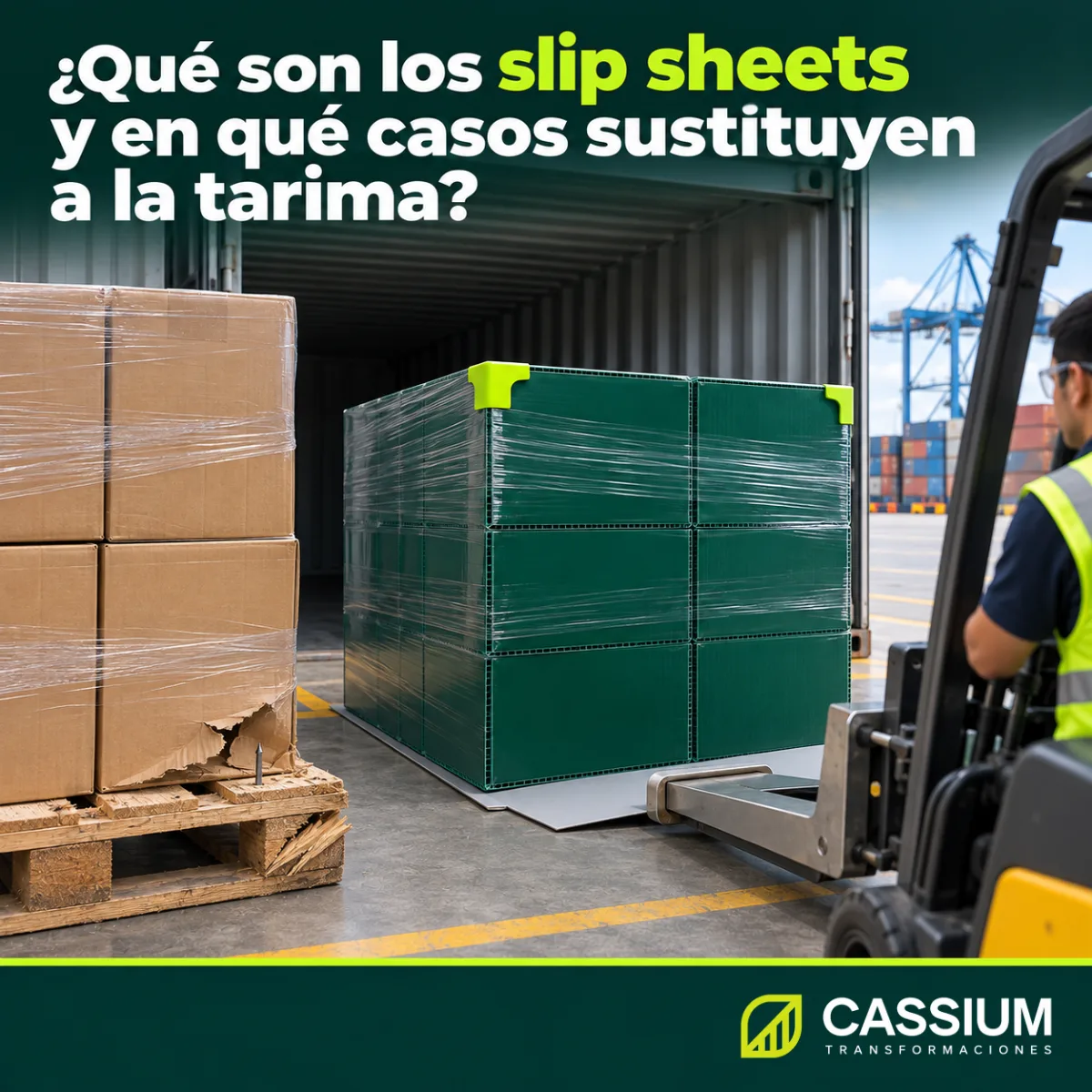
A slip sheet is a sheet with tabs that replaces the pallet under a unit load. It is handled with a forklift fitted with a push-pull attachment, and it pays off in exports, one-way shipments and uniform, high-turnover loads.
What a pallet costs on a trip with no return
The pallet solves handling with forklifts and pallet jacks, which is why it shows up on most docks. In a closed loop, the pallet comes back and is used many times. In a one-way shipment, the pallet leaves with the load, adds weight and height in the truck or container, and ends up as waste at your customer's plant.
Weight and height that travel without being sold
Every pallet adds weight and height to the load. In a truck or container that reaches its weight limit before its volume limit, that weight displaces product. In one that hits its height limit first, the centimeters of the pallet can rule out one more layer per position.
The pallet that never comes back
A pallet that stays at the destination is a purchase that repeats with every shipment. If it is made of wood and the shipment crosses a border, it also requires phytosanitary treatment and the matching mark. If it comes back, someone has to collect it, count it and repair it. The slip sheet eliminates those tasks on trips where the pallet adds nothing to handling.
What a slip sheet is and how the load moves without a pallet
A slip sheet is a thin sheet, the size of the base of the load, on which the boxes or bundles are placed. A tab extends from one or more of its sides, and the load is gripped by that tab to move it. The sheet travels with the load to the destination and accounts for a minimal fraction of the weight and height of a pallet.
The push-pull attachment on the forklift
A load on a slip sheet is handled with a forklift equipped with a push-pull attachment. The attachment has a gripper that clamps the tab and pulls the load onto a platform or onto wide, thin forks. To unload, a plate pushes the load off and sets it down on the floor, in the truck or in the container. Without that attachment, the load cannot be lifted with a conventional forklift or a pallet jack.
Tabs, the side the load is gripped from
Tabs are defined by the side from which the forklift will approach the load. One tab works when the load is always picked up from the same side. Two tabs, on opposite or adjacent sides, give flexibility at docks and in containers. Three or four tabs let you pick up the load from any side, at the cost of more material and more edges exposed to bending. The size and fold of each tab are adjusted to the gripper of the attachment.
Materials, solid fiberboard or plastic
A solid fiberboard slip sheet is light and economical, and it works in one-way shipments with dry cargo. It loses strength with moisture and with condensation inside the container, and its tab tears with repeated handling. A plastic slip sheet tolerates moisture and more handling cycles, and it is reused in flows where the sheet comes back. The choice depends on the humidity along the route, the weight of the load and whether the sheet will come back.
When a slip sheet replaces the pallet
A slip sheet works when three conditions are met at once: the load forms a stable block, both ends of the trip have a push-pull attachment and the product does not need a pallet for storage at the destination. With those three conditions in place, these are the cases where it pays off most.
Export in ocean containers
Without pallets, the container gains usable height and weight for product, and the load arrives with no wood to treat and no pallets for the consignee to dispose of. The savings grow when the route repeats every week with the same product and the same load pattern.
Uniform, high-turnover loads
Beverages, canned food, paper, bagged resins and product in uniformly sized boxes form stable blocks that are stretch-wrapped or strapped onto the sheet. These loads are block-stacked on the warehouse floor, without racks, and there the slip sheet is handled as nimbly as a pallet when the forklift has the right attachment.
Flows between two plants of the same company
When the shipment goes between two of your own plants, the equipment at both ends is defined from the start. Both plants install the attachment, the plastic sheets come back in compact bundles and the pallet fleet shrinks to the pallets that work inside each plant.
Captive pallet in the plant, slip sheet on the trip
One variant combines both. The load is built in the plant on a pallet that never leaves, with a slip sheet between the pallet and the product. When the truck is loaded, the attachment pulls the load by the tab and the pallet stays home. At the destination, the customer receives the load with its own attachment or places it on one of its own pallets.
When to keep the pallet
The slip sheet solves the trip and requires conditions that some operations do not meet yet. It makes sense to keep the pallet in five situations.
- The destination has no push-pull attachment and will not accept unloading by hand.
- The load is stored in selective racking, where each position needs a rigid base that rests on the beams.
- The load is irregular, mixes boxes of different sizes or has a base that deforms under weight.
- The product in the bottom layer is fragile and needs the clearance from the floor that a pallet provides.
- The floor of the warehouse, the dock or the truck has uneven spots, open joints or debris that tear the sheet as it slides.
What the load needs to travel on a sheet
Without a pallet, the load holds itself up. The packaging of each box, the pattern of each layer and the securing of the block do the job the wood or plastic structure used to do.
Boxes modulated to the base of the sheet
Boxes must cover the base of the sheet with no overhang and no gaps. A box that sticks out gets hit by the gripper or by the container wall, and a gap in the bottom layer lets the load tilt when it is pulled. That is why the box size is defined together with the sheet size and the size of the container or trailer.
Packaging that withstands the pull and the push
When the load is pulled, all the force passes through the tab and the bottom layer. The boxes in that layer need walls that withstand friction against the platform and the pressure of the block. Corrugated polypropylene packaging holds its strength in a humid container and keeps its shape at the base when the sheet slides.
Stretch wrap, strapping and corner boards
The block is secured with stretch film, strapping or both. The securing must wrap the sheet together with the first layer, so the load and the sheet move as a single piece on the first pull. Corner boards protect the edges where the strapping tightens and spread the pressure over the boxes on the outside.
How to test slip sheets before retiring the pallets
The change is validated with one route and one product before rolling it out. First, confirm with your customer that its dock has the attachment or that it accepts the captive pallet setup. Then build several loads on slip sheets with the final packaging, load pattern and stretch wrap, move them with the attachment at your plant and ship them on the real route.
At the destination, check the tab, the boxes in the bottom layer and the stability of the block. With that data you decide which routes switch to slip sheets and which keep the pallet. At Cassium Transformaciones we design with you the corrugated polypropylene boxes that form that block, modulated to the base of the sheet and validated with a prototype before producing the fleet.
If your pallets travel every week to a destination they never return from, you are paying for a structure your load no longer needs. At Cassium Transformaciones we design, in Monterrey, the corrugated polypropylene packaging that forms a stable block on the sheet, with boxes modulated to your load and a prototype before production. Tell us how your product travels on our contact page.