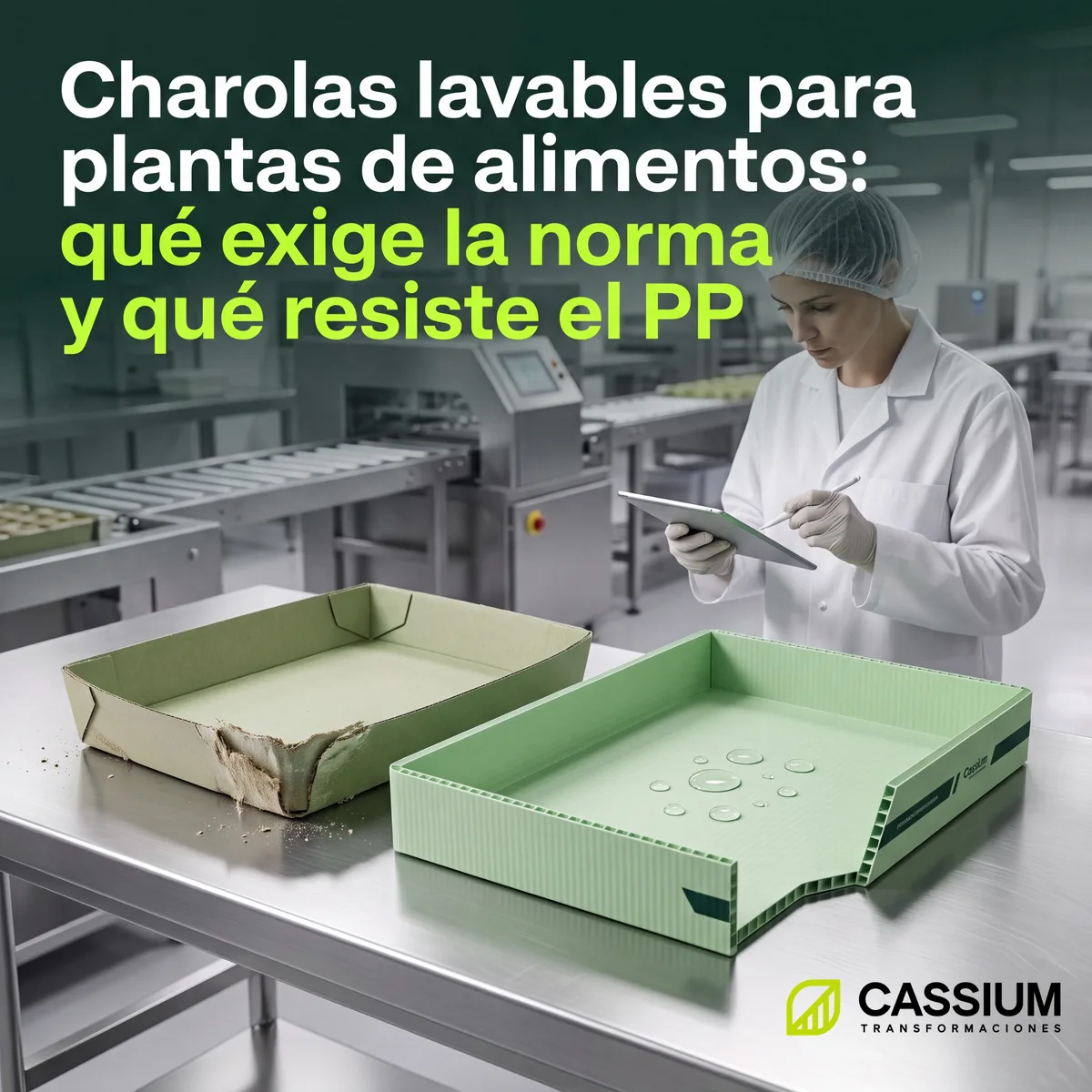
A tray doesn't pass an audit because it looks clean. It passes because the material it's made of meets what's expected of a food-contact surface. At Cassium Transformaciones we manufacture trays and dividers in corrugated polypropylene in Monterrey, and this is the guide we give quality managers before they decide whether to move away from cardboard or other plastics.
What's expected of a surface that touches food
Mexican food hygiene regulation, led by NOM-251-SSA1-2009, along with international food-contact guidelines, agree on the same underlying principle, regardless of what the packaging is made of.
A smooth surface, free of pores and cracks
The core requirement is that the surface doesn't retain residue or moisture within its structure. A porous or cracked material becomes a place where organic residue and moisture build up beyond the reach of normal washing, and that's exactly what auditors look for when they check edges and corners.
Resistance to washing and sanitizing chemicals
It's not enough for the material to tolerate water. It has to tolerate industrial detergent and sanitizer without degrading, without discoloring in a way that hides residue, and without losing structural integrity cycle after cycle. A material that wears down with every wash stops being reliable exactly when it needs to be.
No particle shedding
The material shouldn't shed fragments onto the product either during normal use or during washing. This applies especially to cut edges, corners and high-handling areas, which are where an unsuitable material starts failing first.
These criteria are a general reference. The applicable standard and its specific requirements for your process should always be confirmed by your quality team, since requirements can vary depending on the type of product and the market you export to.
Why cardboard doesn't meet these three points
Cardboard is porous cellulose fiber by nature. It retains moisture within its own structure, softens with washing, and sheds fiber at the edges with repeated handling. It's not that cardboard is poorly made. Its internal structure is exactly what a washable-surface protocol is designed to avoid.
That's why cardboard works well as single-use packaging and fails as a work surface that gets washed and reused on the plant floor.
What corrugated polypropylene withstands
Corrugated PP is a solid plastic, not a fiber. That changes the answer to the three points above.
Zero moisture absorption
Without pores, the surface doesn't retain water or residue within its internal structure. What looks clean after washing is clean, because there's nowhere for moisture to hide.
Repeated industrial washing without losing integrity
We manufacture food-grade trays in 3 to 5 mm gauge, built to withstand pressure washing with industrial detergent cycle after cycle. The piece washes, dries and goes back on the line the same day, without losing strength from one wash to the next.
No particle shedding during use or washing
Polypropylene doesn't wear down at edges and corners the way cardboard does, so it doesn't release fragments onto the product during normal handling or during sanitizing.
Delivers far more cycles before replacement
A corrugated PP piece delivers up to 40 documented uses under normal handling conditions. Cardboard, as a reference, delivers between one and three uses before losing shape. That means fewer pieces to replace and fewer findings for worn material at every audit.
Before you switch
If your plant is evaluating a move from cardboard to a genuinely washable material, the first step is confirming with your quality team the exact standard that applies to your process and target market. The second is defining the right gauge based on the weight and type of product each tray will carry.
We manufacture at our Monterrey plant, ISO 9001 certified, with no imports or middlemen. If you want to review what gauge and size your line needs, write to us and we'll go through it using your operation's own numbers.